
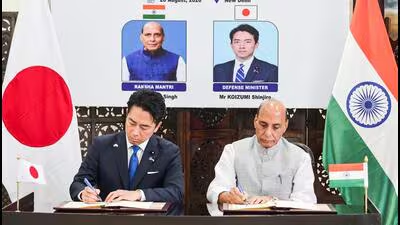
India and Japan on Thursday signed a memorandum of arrangement to deepen maritime security cooperation, focusing on closer ties between the Indian Navy and the Japan Maritime Self-Defense Force—the latest in a series of steps to bolster bilateral military ties—during talks between defence minister Rajnath Singh and his Japanese counterpart Shinjiro Koizumi in Delhi.
Another outcome of the delegation-level talks was the two leaders agreeing to set up a working group to boost cooperation in a raft of areas including operations, intelligence, equipment, technology and industrial cooperation. Singh and Koizumi met weeks after India and Japan unveiled measures to expand cooperation in defence, energy security, rare earths and AI, and finalised a joint roadmap on economic security at the 16th India-Japan Summit, where Prime Minister Narendra Modi and his Japanese counterpart Sanae Takaichi stressed the importance of mutual trust in a world order facing growing uncertainty.
“The arrangement provides a framework for information sharing in the field of maritime domain awareness (MDA), and enhanced cooperation in areas such as search and rescue (SAR) and humanitarian assistance and disaster relief (HADR),” the two sides announced in a joint statement. “The working group will maximise synergies among the various areas of cooperation, and accelerate their implementation,” the statement said. “With a view to further advancing cooperation among the services of the two countries, the two ministers concurred on promoting exchanges between their respective special operations forces and pursuing cooperation with India’s integrated theatre commands following their establishment,” the joint statement added.
This marks a rare, and possibly the first, reference to India’s planned theatre commands in a joint statement. The mention comes at a pivotal moment as the country takes steps to advance theaterisation, a long-awaited reform designed to integrate the military’s resources for future conflicts. The two leaders agreed to strengthen bilateral coordination for protecting sea lines of communication through mutual visits by warships and naval units, joint exercises, personnel exchanges and logistics support, including the use of ports, maintenance and repair facilities.
The ministers agreed “to maximise synergies to enhance mine countermeasures capabilities and explore the possibility of joint development in naval shipbuilding and design by leveraging Japan’s technological expertise and India’s production capabilities.”
