
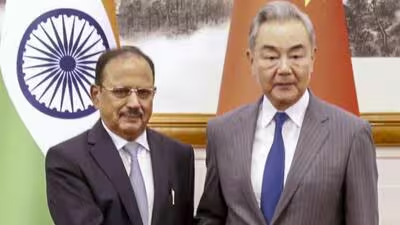
India and China have agreed to take forward talks on an “Early and Substantial Harvest” of boundary delimitation and to promptly address any situation to avert “misunderstanding and miscalculation” along the Line of Actual Control (LAC) during talks between the Special Representatives on the border issue.
“The Expert Group on Boundary Delimitation and Working Group on Border Management under the WMCC [Working Mechanism for Consultation and Coordination] would respectively advance discussions on an Early and Substantial Harvest of boundary delimitation and Border Management,” the joint statement said without going into details. The first task for both the groups will be to agree on their respective terms of reference, the joint statement said. A joint statement issued by the two sides on Wednesday said the Special Representatives – India’s National Security Adviser Ajit Doval and China’s foreign minister Wang Yi – reached eight points of outcomes and consensus, including holding a meeting of an Expert-Level Mechanism on Trans-border Rivers in September.
They will also advance negotiations on a framework for settling the border in line with the Agreement on Political Parameters and Guiding Principles for Settlement of the India-China Boundary Question signed in 2005, and the consensus reached in Special Representatives’ talks in pursuit of a fair, reasonable and mutually acceptable solution.
The two sides will hold the next meeting of the India-China Expert-Level Mechanism on Trans-border Rivers in September and “maintain communication on issues including hydrological data sharing, and renewal of the relevant MoUs”, the joint statement said. As part of the outcomes, India and China will uphold the guidance received from Prime Minister Narendra Modi and President Xi Jinping, maintain peace and tranquillity in the border areas and “create an atmosphere for healthy and steady development of bilateral relations”.
