
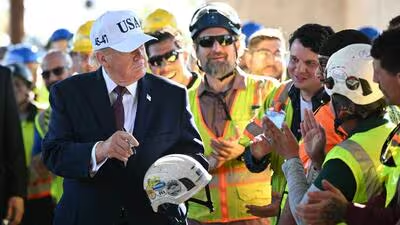
Washington: Democrats will control both chambers of the US Congress from January after decisive wins in the November 3 midterm elections, giving them sweeping powers to check President Donald Trump’s domestic agenda, though the 80-year-old President retains wide latitude over American diplomacy. The return of divided government to Washington has implications for several issues that matter to India.
Most of the Trump administration’s curbs on these workers and students came through proclamations and agency rules that need no approval from Congress. Large new charges may be the exception. A federal judge in Boston ruled in June that the $100,000 H-1B fee Trump announced in September 2025 was a tax Congress never authorised, a ruling the administration is appealing. The same test would apply to a $100,000 fee the administration is considering for students using the Optional Practical Training (OPT) programme to work in the US after their studies.
Bejarano said H-1B visas could be “a potential area that they prioritize, given that there’s a lot of corporate backing in the United States for these programs”. But he cautioned that “most people will be surprised that over the coming years that perhaps Democrats aren’t as intense about perhaps undoing some of the president’s immigration policies”. “I don’t necessarily see it being the case that Democrats will come in in January 2027 and try to completely rewrite the immigration book,” he said, though “these kind of specific visa categories can be places where Democrats can affect and reverse policies that have been instituted”.
The incoming Democratic majorities have made ending the war a top priority. Both chambers narrowly passed a resolution in June directing Trump to halt military action against Iran, but the administration brushed it aside. The party’s real leverage lies in spending, though the Pentagon’s existing funds mean operations need not stop at once even if Congress refuses new money. Trump can veto any such bill.
Indians accounted for an estimated 71% of approved H-1B visas, which let US employers hire skilled foreign workers, in recent years, according to US government figures reported by PTI. India also sent 363,019 students to the US in 2024-25, more than any other country, according to the Institute of International Education, a US non-profit.
“Democrats can include language in spending bills that prevent the administration from using military funds for unauthorized military conflict, and we would certainly expect Democrats to do that,” said Eddie Bejarano, Americas analyst at Dragonfly, a Dow Jones intelligence service. “The tariff actions undertaken by Trump so far don’t require action by the Congress, and the agreements that Trump’s been negotiating, including the agreement with India, are what the administration would describe as executive agreements,” said Mark Linscott, senior adviser at the US-India Strategic Partnership Forum. Such deals do not need the trade promotion authority legislation that free trade agreements require, he said, an approach used by plenty of past administrations.
He was less sure about the trade deal, which Indian and American officials say is close to completion.
He said some in Delhi expected Trump’s defeat to delay the interim agreement, which he said would be unfortunate as the agreement “is in the interest of both countries”. “If there is a perception in the Trump administration that India is dragging its feet again, or is not interested in concluding the interim agreement, then we could see higher tariffs than we would otherwise see under Section 301,” he said, adding that it could also raise the risk of tariffs under the Graham law.
