
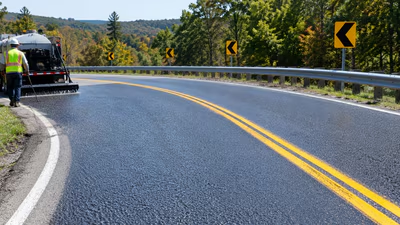
A sharp curve on Pennsylvania’s Route 611 had a persistent safety problem that conventional road signs and markings could not solve. In 2007, the Pennsylvania Department of Transportation (PennDOT) tried a more targeted solution: a high-friction surface treatment on about 800 feet of the curve. When rain covered the pavement, drivers faced a combination of low surface friction and difficult road geometry, increasing the risk of skidding and leaving the roadway.
The consistent finding was that wet-weather crashes were a recurring problem at the curve. PennDOT had already attempted relatively conventional measures, including additional warning signs, chevrons, and improved pavement markings. They did not adequately address the underlying friction problem. This was the first time the department had utilized HFST, serving as a pilot project. The treatment used calcined bauxite aggregate and epoxy resin. HFST is a thin layer of highly skid-resistant aggregate. Unlike regular aggregates, which can become polished by traffic, calcined bauxite is chosen for its ability to retain friction . The treatment produced a clear improvement. The key result came after the road surface was treated. With help from the FHWA’s Every Day Counts initiative, PennDOT continued to increase the number of treated areas.
FHWA’s case study reports 13 wet- pavement crashes over 10 years in the southbound direction. Other PennDOT and FHWA materials cite different periods and totals, including 20 wet-pavement crashes over 10 years and 21 over five years, reflecting different evaluation windows. The HFST treatment was applied to about 800 feet of the southbound curve in June 2007 in the same direction where the past accidents took place. Prior to HFST treatment, the average skid number was 24. After HFST treatment, the average number was around 75. In July 2010, the average skid number was 71. FHWA also notes that the site remained crash-free during eight years after treatment of the road in 2007. This encouraged PennDOT to go beyond the pilot project and treat 14 other spots with high incidences of wet-pavement crashes in 2012. By the end of 2015, PennDOT had treated 150 sites.
