
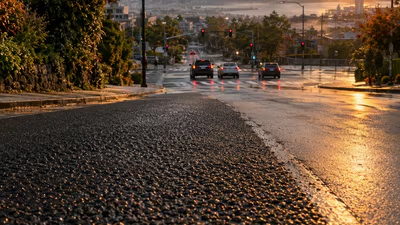
A case study from the Federal Highway Administration (FHWA) revealed that the city tried several common fixes, to no avail. So, it changed the pavement in October 2004. Crashes at the intersection declined 78%, and costs related to crashes declined 83%.
We trust road signs to keep us safe. Flashing signs, road markers, and street lights all try to keep drivers alert. But what if the road itself needs fixing? That was the question at a downhill intersection in Bellevue, Washington. The story shows how important a road surface can be when drivers have to stop on a slope, and it has a few limits worth knowing.
The problem was not lost on Bellevue. The trouble spot was an intersection where drivers came downhill. The agency notes intersections have built-in challenges, including limited sight distance to stop and additional braking distance on downhill approaches. The city had already tried a large flashing warning sign at the bottom of the grade, the case study noted. It had also put in road markers, new street lights, and raised pavement buttons. All of them were to make the spot safer. But those initial measures didn’t produce the desired results. That is an important lesson. A sign can tell a driver to slow down, but it cannot help a tire grip the road when the driver needs to stop. The case study identifies the product as Tyre-grip. This type of treatment improves the friction characteristics of the pavement, allowing vehicles to better handle conditions such as restricted sight distance and the need for more braking distance on downgrades. Friction is nothing more than the grip between a tire and the road. It’s like changing from slick shoes to shoes with deep treads.
In October 2004, Bellevue applied a high friction surface treatment, or HFST, to the downhill approach to the intersection.
That’s a lot of change for a single intersection. But a word of caution is helpful here. The summary does not report the raw crash counts or the duration of the study period. So these numbers should be seen as the before-and-after result of one site and not as a promise for every road. Other changes, including traffic shifts, can also influence crash numbers at a single location, which is why one story is not enough to resolve the question. One site is a story, not proof, so it’s helpful to look at bigger studies. Merritt, Craig A. Lyon, Bhagwant N. Persaud, and Helga N. Torres studied hundreds of installations in Arkansas, Georgia, Kentucky, Louisiana, Pennsylvania, and West Virginia. The team used crash data from before and after. They found important benefits, especially for crashes in wet weather. For curves, the researchers also saw a consistent link between the size of the benefit and three things: how much friction improved, how busy the road was, and how many crashes were expected before treatment. However, there’s a fly in the ointment. That study was for curves and ramps, not intersections like Bellevue’s. So it backs up the general idea of the treatment on curves and ramps, but it doesn’t confirm Bellevue’s numbers or show how the treatment performs at intersections. Still, the two sources point in the same direction. Bellevue’s result is encouraging, and the wider research backs the idea of adding grip where drivers need it most.
The treatment reduced crashes at the intersection by 78% and the cost of crashes by 83%, according to the FHWA. In plain terms, 100 crashes before would shrink to about 22 after. A 2020 FHWA research report by David K.
