
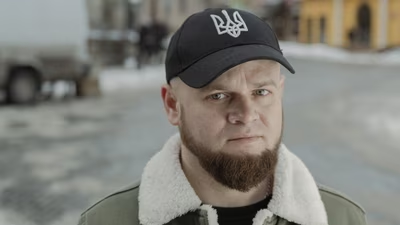
KHARKIV, Ukraine—Before he left for the front line in 2022, Serhii Boychuk told his wife that if captured, he didn’t want to be taken alive. A few months later, the Russians took him prisoner. Guards beat and tortured him sexually for more than two years, he said.
Event Context
Other Ukrainian former detainees described similar experiences of sexualized torture while in Russian prisoner-of-war camps. Their accounts match the findings of Ukrainian prosecutors and intelligence services and United Nations investigators, who have conducted extensive interviews with former prisoners—both soldiers and civilians—throughout the more than four-year war.
This growing body of testimony suggests that Russian sexual violence against POWs and civilian prisoners has been systematic—and condoned, even encouraged, by senior Russian officials.
Sexual violence in war has long been used to subjugate and terrorize civilian populations. In many conflicts, the most common targets are female civilians.
“Sexual abuse is the cheapest method of waging war,” said Anna Sosonska, a Ukrainian prosecutor who has brought charges against Russian soldiers in absentia. The national prosecutor’s office, where Sosonska works, is overseeing around 400 cases involving alleged sexual violence by Russian soldiers against civilians. Some 148 of the alleged victims were men.
“They are using sexualized abuse as a weapon of war to humiliate and break the person,” said Boychuk. After a seemingly never-ending ordeal, he was released in October 2024 as part of a prisoner swap.
Other former POWs and civilian detainees who spoke to the Journal said they were forced to stand, crouch or parade naked. Some had their genitals electrocuted. Some were raped—either with objects such as bottles or sticks, or by Russian guards.
Some of the former detainees, who were held at various sites in Russia, recalled guards telling them that they would stop Ukrainians from having children.
Some said the guards threatened to insert building foam into their anal passages, where it would expand and harden.
“It is the same evidence, the same way of treatment, it all follows a pattern,” said Mykhailo Romanov, a lawyer with the Kharkiv Human Rights Group, a research and advocacy group that has collected testimony from 11 former POWs.
Such repetitive patterns suggest that the alleged crimes weren’t simply the acts of individuals, but were committed as a feature of Russia’s military campaign, said David Schwendiman, a former U.S. and international prosecutor who investigated war crimes perpetrated in the 1990s war in Bosnia.
Sivak, who was freed before Russian forces retreated from Kherson, now runs a support group for around 200 Ukrainian men who allege torture at Russia’s hands. The 42-year-old says he copes with his trauma by sharing his story with other victims and the public.
All Ukrainian former POWs interviewed by the U.N. reported torture or ill treatment at Russian camps, and over 70% said it involved sexual abuse. Meanwhile, around half of Russian captives who spoke to the U.N. said Ukrainian forces had mistreated them in some way, of whom less than 5% said they had experienced sexual abuse.
Team Analysis
Early in the war, Halyna Tyshchenko, a 63-year-old former market stall trader, says she was raped by a Russian soldier at gunpoint in her lounge and then brought outside and paraded naked along the street in below-freezing temperatures.
The soldier’s unit was stationed in a house some 400 yards away, Tyshchenko said. She strongly suspected the man’s officers were aware of the abuse.
In the first year of the invasion, after Russian forces overran his home city of Kherson, Oleksiy Sivak hung up a Ukrainian flag on the country’s independence day.
The Russians threw him in jail. They showed him an old army field telephone and mockingly told him it was time to call then-President Joe Biden. Then, he said, they attached the phone’s wires to his genitals and gave him electric shocks.
It is a torture used widely in the Russian prison system and the distribution of these old phones shows complicity from senior figures, Ukrainian investigators say. Prison guards refer to it as a “call to Putin,” or in earlier times a “call to Lenin,” the U.N. has noted.
POWs and civilians have been abused in nine different camps inside Russia, the U.N. says. Ukrainian investigators say the treatment was particularly bad in seven of them.
A Ukrainian government spokesman said that instances of sexual abuse in Ukraine are considerably fewer than those committed by Russia. He said these cases are being investigated and that Ukraine—unlike Russia—allows international observers to visit detention centers.
Match Outlook
“No one in command could claim under the circumstances not to have known what was happening, even if they did not give orders to those under their control to do it,” he said.
Naumenko couldn’t be reached for comment.
Russian POWs who spoke to the Journal said they were never given clear instructions against sexual abuse, but said some individual officers made their disapproval clear. In contrast, Western militaries drill into their soldiers that such abuse is illegal.
“Back then, in the Russian basement, I was screaming so hard that the whole world could hear,” he said. Now, he says, he wants to tell the world what happened.
source
Russian forces committed a large number of sexual assaults against Ukrainian women when they overran towns and villages early in Moscow’s full-scale invasion, launched in 2022, according to the U.N. and interviews conducted by The Wall Street Journal.
But since the war settled into a slow, attritional contest, many of the known victims have been male Ukrainian soldiers captured on the battlefield.
The U.N. says it has so far gathered testimony in about 310 cases of alleged sexual violence by Russian forces during the war. The violence described includes rape, gang rape, genital mutilation, electric shocks and beatings to the genitals, the U.N. said. Among the victims were 280 men, 26 women and four girls.
The Kremlin and Russia’s Federal Prison Service declined to comment. Russia has previously denied accusations of sexual abuse, saying they are unsubstantiated and politically motivated.
Investigators caution that the extent of continuing sexual and other abuses against civilians in the Russian-occupied zones of Ukraine is only partially understood.
Russia has persistently denied access to occupied areas to U.N. officials investigating conflict-related sexual violence, the body’s secretary-general said in a report in April. Fear of retaliation and stigma related to sexual violence has also prevented male and female victims from reporting abuse.
Abuse is sometimes sanctioned from on high. The chief prison official in St. Petersburg told guards in charge of Ukrainian POWs that there were no restrictions against violence, which often included sexual abuse, according to former prison officials who spoke to the Journal.
Civilians from occupied parts of Ukraine have also fallen victim. At one camp in Russia’s Rostov region, prosecutors allege that Aleksandr Naumenko, a senior official in Russia’s national guard, ordered military personnel to sexually assault 17 civilian prisoners, according to Ukrainian court documents. Investigators showed former captives Naumenko’s photo, which they recognized.
Russian forces use sexual violence and other torture to punish, humiliate or extract information or confessions, according to former POWs, Ukrainian prosecutors and U.N. officials.
Some guards simply appeared to enjoy it, former captives told the Journal.
Ukrainian forces have also been accused of abusing captured Russians, albeit not on the same scale.
The U.N. says Ukrainian authorities have given its monitors access to prisoners of war and civilian detainees, unlike in Russia. Most cases of alleged sexual abuse at Ukrainian facilities happened before 2025, according to the U.N.
Most cases of mistreatment by Ukrainian forces happened near the front line after Russian soldiers were captured, but Russian POWs were generally treated correctly once they were in Ukrainian prison facilities, a previous U.N. report and captives interviewed by the Journal said.
Write to Alistair MacDonald at [email protected]
