
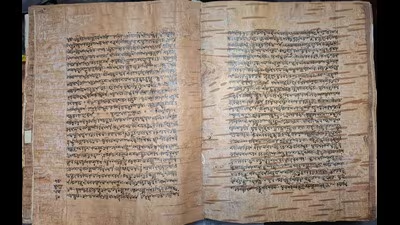
PUNE: A rare 16th-century birch-bark manuscript of the Mahabharata, recently recognised by UNESCO, travelled from Kashmir to Pune before becoming part of the Bhandarkar Oriental Research Institute’s (BORI) collection in 1970.
The recognition was announced following the 11th session of the Memory of the World Asia-Pacific Regional Register in Jakarta, Indonesia. Its inclusion in UNESCO’s Memory of the World Asia-Pacific Regional Register has drawn international attention to the manuscript and BORI’s contribution to Mahabharata research. The manuscript is significant for its role in BORI’s landmark Critical Edition of the epic, which sought to establish a text through systematic comparison of manuscripts from different regions. Shreenand Bapat, who helped prepare the UNESCO nomination, described it as one of the purest textual forms of the Mahabharata. “It is supposed to be one of the purest texts of the Mahabharata. “We cannot say who wrote it or who might have used it. A manuscript written on birch bark Unlike paper, birch bark was prepared from the tree’s inner, softer layer, with the outer layer removed to create a thin writing surface. It is found in Kashmir, Himachal Pradesh, Uttarakhand and some other Himalayan regions. The soft bark is peeled off and used for writing. The material, script and text together offer an important record of India’s manuscript traditions and the transmission of knowledge across generations. “Mahabharata is something inbuilt; we can call it the soul of the institute. The Sharada manuscript was particularly valuable to the exercise. Its decipherment required specialised knowledge of the script, with Bapat and Amruta Natu among the scholars involved. The manuscript is also fragmentary. It contains only three Parvas: Adi, Sabha and Aranya. BORI’s sixth UNESCO recognition The latest recognition marks an institutional milestone for BORI. This is the sixth one which has got this status, and we will be applying for a few manuscripts to get this status. The Rajatarangini, a 12th-century chronicle of Kashmir by Kalhana, and Kautilya’s Arthashastra were also included in the regional register. The manuscript’s journey from Kashmir to Pune, its contribution to the Critical Edition and its continued preservation at BORI make it an important link between India’s literary past and present.
German-born Indologist and Sanskrit scholar Georg Bühler brought the manuscript to scholarly attention in 1875, documenting it during his research on ancient Indian manuscripts. Written in the ancient Sharada script across 358 pages of birch bark, traditionally known as bhurjapatra, it is among the rarest surviving records of the Kashmiri recension of the epic. Before 1875, who used it and so on is not known. Explaining the material, Bapat said, “Birch is a tree which grows between 3,000 and 5,000 metres above mean sea level. BORI received the manuscript in 1970, and it has remained in the institute’s care since then. A landmark exercise in reconstructing the Mahabharata BORI’s Critical Edition project, undertaken between 1919 and 1966, was one of the most extensive exercises in textual scholarship involving the epic. 1,259 manuscripts were collected, according to the project’s records. BORI’s executive board chairman said scholars examined around 1,400 manuscripts, of which approximately 700 were selected for preparing the Critical Edition. In fact, there were 1,400 manuscripts which were studied by our scholars. Out of these, 700 manuscripts were selected to make the Critical Edition of the Mahabharata,” he said. Of the 17 Indian entries in UNESCO’s Memory of the World Asia-Pacific Regional Register, the Mahabharata manuscript is the sixth recognition secured by the institute, according to its executive board chairman. “We have around 20,000 manuscripts, and the manuscripts are very carefully selected.
Because of the fragility of the material, preserving birch-bark manuscripts presents particular challenges.
The manuscript dates to the 16th century, and it has become the basis for the Critical Edition of the Mahabharata, particularly some early parvanas (sections of the epic),” he said. What we can say is that it was used for the Critical Edition of the Mahabharata by the general editor V S Sukthankar and other scholars,” Bapat said. Natu, who worked on the Sharada manuscript, said its significance lay in its representation of the Kashmiri recension, making it an exceptionally rare surviving record of the epic’s textual history. “It is the shortest version available and, according to Professor V S Sukthankar, this is the only extant representative of the Sharada or Kashmiri version. We do not have another authentic manuscript on birch bark and in Sharada,” she said. This process is going to be continued,” he said. Bapat said the manuscript is in good condition and is permanently displayed at the institute for visitors.
There is no established information about its original scribe, who preserved it or who used it before Bühler brought it to scholarly attention. the manuscript’s earlier history remains largely unknown While its presence was documented in 1875.
