
The story so far:
Over-speeding and reckless driving, poor road upkeep, inadequate driver training, and weak emergency and trauma care continue to make road crashes a severe public-safety crisis. India has the world’s largest road network, spanning about 6.7 million kilometres, larger than the U.S.’s 6.59 million km and China’s 5.49 million km, but it also records the world’s highest road fatalities.
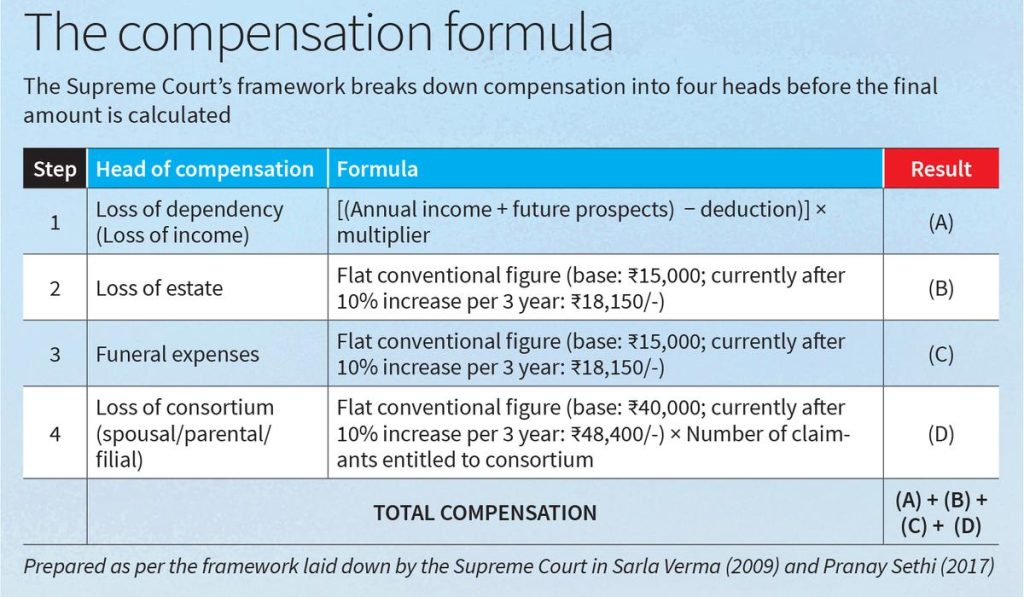
The insurer, owner, and driver are ordinarily parties to the proceedings, as the Tribunal must determine both the amount of compensation and the party liable to pay it. The claim is ordinarily first heard by the MACT, which is the primary fact-finding and compensation-awarding forum. In determining liability, the Tribunal typically examines the FIR and chargesheet, site plan, Mechanical Inspection Report, post-mortem report or medical/disability records, insurance policy, and the depositions of eyewitnesses and the investigating officer, etc. Liability initially attaches to the negligent driver and, vicariously, to the owner of the offending vehicle. Where the vehicle is insured, the insurer generally satisfies the award. The second stage is to translate these three facts into the four heads under which compensation in a death case is computed: (A) loss of income/dependency, (B) loss of estate, (C) funeral expenses, and (D) loss of consortium.
Under Section 166, a claim may be filed by the injured person, the owner of damaged property, or, in case of death, by all or any of the deceased’s legal representatives (LRs). An appeal under Section 173 may be filed before the High Court within 90 days, subject to the depositing of ₹25,000 or 50% of the awarded amount, whichever is less. Section 146 mandates compulsory third-party insurance, while Section 150 requires insurers to satisfy awards arising from third-party risks, subject to limited defences under Section 150(2), including specified policy breaches, unauthorised use, driving without a valid licence, and non-disclosure or misrepresentation in obtaining the policy. As delineated in para 61 of Pranay Sethi (2017), for a person in a permanent government or salaried job with assured career progression, 50% is added where the deceased was below 40 years, 30% where aged 40–50 years, and 15% where aged 50–60 years; no addition is made above 60 years. For a self-employed person or one on a fixed salary, the corresponding additions are 40%, 25% and 10% for these three age groups, respectively, with no addition above 60 years.
Even where a defence is established, courts may apply the “pay and recover” principle, directing the insurer to pay the victim/LRs first and recover the amount from the owner or driver thereafter. A separate “no-fault liability” route dispenses with proof of negligence and provides compensation of ₹5 lakh for death and ₹2.5 lakh for grievous hurt (post the 2019 amendment), payable by the owner or authorised insurer, without proof of negligence. The major component is “loss of income”, which represents the financial loss suffered by the dependants on account of the victim’s death. For the first head, the calculation begins with the deceased’s “annual income” to which the prescribed percentage towards “future prospects”, having regard to the deceased’s age and nature of employment, is added. From the resulting figure, the prescribed “deduction” towards the deceased’s personal expenses is made, and the balance is multiplied by the appropriate “multiplier” to arrive at the “loss of income”. The aforesaid three components perform different functions: “future prospects” account for the career growth the deceased would reasonably have received had they survived.
The Motor Vehicles Act, 1988 (MV Act) is the principal law governing motor-accident compensation. For adjudicating claims, Section 165 empowers State governments to constitute Motor Accidents Claims Tribunals (MACTs) for specified areas to determine claims arising from motor-vehicle accidents. The MV Act creates a statutory scheme covering the entire accident chain, from regulation and driver and owner duties to insurance, liability, investigation, and compensation. Importantly, the same accident may generate two distinct proceedings: a criminal case for offences such as rash or negligent driving, and a separate MACT claim for compensation. As held by the apex court in Reena v.
Managing Director, KSRTC (2026), an acquittal in the criminal case does not affect the MACT proceedings, since the two operate in distinct legal spheres and apply different “standards of proof”.
