
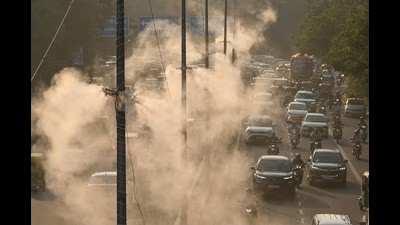
Hour-by-hour readings show the pollution level in Delhi started surging on Tuesday evening, as Dussehra effigies burned, while the two previous nights of similar weather produced no such spike.
Delhi’s air quality index (AQI) in the Central Pollution Control Board’s (CPCB) 4pm bulletin rose from 179 on Dussehra, Tuesday October 20, to 245 on Wednesday, the season’s highest and one point below July 13’s 246; the 66-point jump was the third-largest after Dussehra since 2015. Because the weather changed little from the two nights before, Dussehra night gives a rough measure of what one evening of celebrations does to Delhi’s air.
The celebrations drove the surge, and the weather made it worse. Nearly all the extra pollution was fine particles while traffic emissions rose about as much as on the two evenings before, which points to the effigy burnings. What the data cannot say Nor can the data exclude a small crop-smoke share, since satellites miss fires lit between their passes. CPCB’s real-time figures are also provisional, and the board can revise them.
The data cannot say how much came from the effigy burning itself, firecrackers, other fires, traffic or chemistry in the damp air, but makes evident a link between the celebrations and the surge in PM2.5 levels. Wednesday’s lower, stiller inversion accounts for only part of the jump, since calm, damp nights under strong inversions, one of them stronger than Wednesday’s, held PM2.5 at 67-90 µg/m³ on the two nights before. Crop smoke cannot on their own explain such strong jump: fire detections in Punjab and Haryana fell from 121 on October 18 to 22 on Dussehra, and the north-westerly winds that could carry it to Delhibrought no spike the two previous nights.
Most PM2.5 comes from burning, as smoke or as particles that form from combustion gases, while dust is mostly coarse, so a fine share that climbs while the coarse part holds steady means the extra pollution was fine particles. Carbon monoxide and nitrogen dioxide, a gauge of how much traffic exhaust the still air held, rose by similar amounts on all three evenings, while PM2.5 rose about three times as much on Tuesday, so whatever was added between 6pm and 11pm was far richer in particles than exhaust — particularly since there would have been no evening peak hour traffic on a festival holiday. Checked against CPCB’s measured values for October 18-21, the conversion was within 0.1 µg/m³ at the typical station-hour.
For figures from earlier in the month, HT converted CPCB’s index scores into concentrations using the board’s own table.
