
Cities are rarely born in a single moment. They emerge slowly—from dreams sketched on drawing boards, the sweat of workers, the resolve of administrators, and the quiet hopes of ordinary people. Yet every city has a day when those dreams take tangible form, and for Chandigarh, that day remains etched in the collective memory of generations.
Having lost Lahore, Punjab needed a capital, but Chandigarh rose as something far greater: A bold declaration of hope. For me, Chandigarh’s inauguration has always been more than a chapter in a textbook. It is a cherished family story, retold over countless evenings, where history mingles with affection and memory acquires the warmth of lived experience. My maternal grandfather, Chaudhary Hem Raj, was serving as the tehsildar of Kharar when the city was inaugurated. Among the many responsibilities entrusted to him was one that might appear modest in official records, but has since become legendary in our family: procuring the thousands of laddoos distributed to mark the occasion. Every celebration needs its symbols, and on that day, the humble laddoo carried the weight of a young nation’s aspirations. I often imagine that morning. Freshly laid roads stretched across what had recently been fields and villages. Officials hurried between ceremonial arrangements, workers made final preparations, and distinguished guests gathered. Somewhere amid the organised bustle stood my grandfather, ensuring every detail under his charge was executed with the quiet efficiency that defined an entire generation of civil servants. Independent India was still young, carrying the deep wounds of Partition while nurturing radical dreams of renewal. It was meant to be a place where modernity coexisted with nature, where broad avenues replaced crowded lanes, and where urban planning itself became a symbol of national confidence. History remembers visionary leaders, world-renowned architects, and sweeping speeches. Yet behind every landmark moment stand countless unsung individuals—revenue officials, clerks, drivers, craftsmen, laborers, and suppliers—who became silent participants in constructing a world-famous city. Whenever my family recalls my grandfather’s role, it is never just about the laddoos. It is about a generation for whom public service was a matter of honour, not recognition. They believed no task was small if it served a larger purpose. Whether managing land records, maintaining order, or ensuring guests shared in the sweetness of a historic celebration, every duty deserved sincerity. Concrete alone does not build a city; it is built by countless invisible acts of dedication remembered only within family walls. The laddoos distributed on inauguration day disappeared long ago, their sweetness lasting only a moment. But the memory endures. It survives in fading photographs, family conversations, and the quiet pride of knowing someone we loved played a part in one of independent India’s defining moments. History lives not only in archives and stone monuments, but around family dining tables, where stories are lovingly retold until they become part of a city’s soul. [email protected] The writer is a Chandigarh-based HT columnist
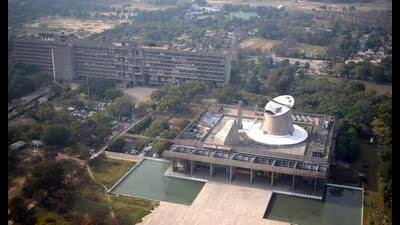
Today, as Chandigarh’s tree-lined boulevards echo with the footsteps of new generations and its iconic Capitol Complex stands tall, I think of those quieter stories history overlooks.
