
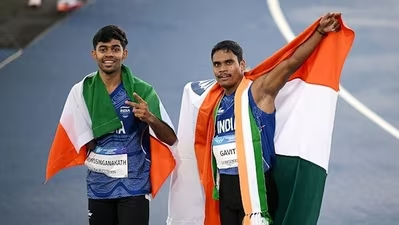
India scripted a historic 1-2 finish in para-athletics on Wednesday in Glasgow as Dilip Mahadu Gavit clinched the nation’s third gold medal at the 2026 Commonwealth Games, winning the men’s 100m T47 final in a Games Record time of 10.71 seconds. Fellow Indian Mohammed Basil Morssinganakth settled for silver.
Event Context
For much of the race, Morssinganakth and England’s Kevin Santos appeared locked in a battle for gold, but Gavit, running in the outside lane, produced a blistering finish over the final 30 metres to storm past both and rewrite the Games record. Morssinganakth crossed the line in 10.83 seconds, edging Santos by just 0.02 seconds for silver.
Murali Sreeshankar, meanwhile, etched his name into Commonwealth Games history by becoming India’s first double medallist in men’s long jump. Having won silver in Birmingham in 2022 with a leap of 8.08m, the Kerala athlete bettered that mark by a solitary centimetre to claim another silver in Glasgow with 8.09m.
Before Sreeshankar, India’s only medallists in the event were Suresh Babu (men’s bronze, 1978), Anju Bobby George (women’s bronze, 2002) and M. Prajusha (women’s silver, 2010).
Sreeshankar announced his intent early in the competition with an 8.09m jump on his second attempt, briefly moving into the lead before former world champion Tajay Gayle of Jamaica responded with the winning leap of 8.15m.
Scotland’s Stephen Mackenzie, who had opened with 8.08m, looked set to overtake both Gayle and Sreeshankar with a huge fifth-round effort, only for the jump—estimated to be well beyond 8.20m—to be ruled a foul by the narrowest of margins. His final jump of 8.06m earned him bronze.
The other Indian in the field, Lokesh Sathyanathan, finished fifth with a best effort of 7.97m, achieved on his opening attempt.
Player Focus
The medal carried added significance for Sreeshankar. In April 2024, he suffered a ruptured patellar tendon that required surgery, forcing him to miss what would have been his maiden Olympic appearance in Paris. The injury had raised doubts over whether he would ever return to his explosive best.
