
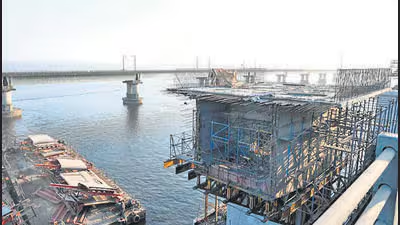
MUMBAI: The Bombay High Court has rejected the proposed compensation of around ₹ 141 crore to the fishing community affected by construction of the Thane Creek Bridge-III, holding that the report submitted by the Tata Institute of Social Sciences (TISS) lacked scientific tools to assess the actual impact and damage. The court, however, noted that the fishing community has been impacted and directed a task force to determine the compensation based on data and government policy within six months.
The court was hearing a bunch of petitions filed by the Mariyayi Machhimaar Sahkari Sanstha Maryadit and Koperkhairane Machhimaar Sarkari Society Maryadit, on behalf of the fishing community from Vashi, Juhu, Koparkhairane, Ghansoli and Diva, who claimed their livelihood has been adversely impacted by construction of the bridge. They are seeking compensation, contending that they were inhabitants of the Thane creek area and their customary right to fish in the creek was adversely affected by the construction of the third bridge on the creek, which connects Mumbai with Navi Mumbai.
The court, however, noted that the TISS report had relied on self-declaration forms from the Project Affected Persons (PAPs), without corroborating the numbers with official statistics available with the Fisheries Department or the municipal corporation. It further noted that TISS has also included livelihood support compensation for six years without adequately assessing the actual impact on their livelihood, rehabilitation or pre-settlement in its true sense. In May 2025, the court appointed TISS to acknowledge the impact on the fishing community. Its report provided a total financial outlay with compensation of ₹ 94 crore towards direct loss from 2021-22 to 2024-25, and ₹ 141 crore towards livelihood security compensation for six years, from 2025-26 to 2030-31.
However, the court said the fishing community is still entitled to compensation “but it has to be awarded based on identification of actually affected families and shall be computed on the basis of evidence-based assessment of impact”.
