
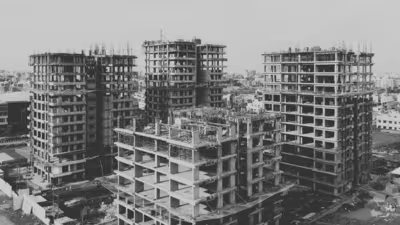
The Union housing ministry’s advisory on Friday, asking real estate regulatory authorities to give builders four extra months to finish their projects, is a response to a supply shock that has been building since late February.
Event Context
After the war broke out in West Asia on February 28, developers have been watching three costs daily: the price of oil, the price of shipping a container to India, and the price of a dollar. Each of those numbers has been finding its way into real estate project costs in India.
The Andhra Pradesh unit of the Confederation of Real Estate Developers’ Associations of India (Credai) had told the state government back in April that the cost of a bag of cement had risen from ₹240 to ₹300, and a tonne of steel from ₹50,000 to ₹70,000 after the war had begun.
JLL India, in its Construction Cost Guide released in March, projected that costs would rise 3-5% this year across all asset classes. The numbers being flagged from the ground since April have run even higher.
The connection to West Asia works through three channels, each hitting a different part of the basket.
Also read: Delayed possession: Can a real estate developer seek review of an MahaRERA order favouring a homebuyer?
India makes almost all its own cement and steel.
The ministry of steel reported crude steel production of 168.4 million tonnes in the financial year 2025-26, with total capacity of about 222 million tonnes, enough to make the country a net exporter. Construction and infrastructure account for about 68% of that demand, government data shows.
Brent crude, the international benchmark, was trading at about $70 a barrel on the day the war began. Within two months, it had hit a post-war peak of more than $126 a barrel on April 30. A brief ceasefire pushed it back down to below $71 in early July, but reignited hostilities in the Gulf sent it climbing again, closing at around $86 on July 31, up more than 20% for the month.
A second, smaller set of materials sits even closer to the barrel. Waterproofing chemicals, PVC pipes, paints and many adhesives are made from petroleum. When crude climbs, they climb with it, almost tick for tick. That is why waterproofing products showed up on Credai Ahmedabad’s list of items with the sharpest price rises.
Also read: West Asia crisis: Homebuyers question 4-month RERA project timeline extension, seek equal relief
Some inputs still come from abroad. Turkish and Iranian stone for cladding, European lifts and façade glass, high-end MEP equipment — these arrive by container ship.
The cheapest route to India from Europe and the eastern Mediterranean runs through the Red Sea and the Suez Canal, or through the Strait of Hormuz.
Both are now contested. Since Houthi attacks resumed and the US-Iran conflict widened, container ships have been sailing around the Cape of Good Hope, adding roughly two weeks to each Asia-Europe voyage.
The extra fuel and the higher insurance premiums show up on the Drewry World Container Index, a benchmark tracked weekly by the London-based shipping consultancy Drewry.
The index hit $4,639 per 40-foot container on July 9, its highest level since September 2024. It eased slightly to $4,255 by July 30 as some rates cooled, but stayed far above pre-war levels.
Drewry has said the Strait of Hormuz is now a permanent cost factor rather than an acute crisis — carriers have baked the longer voyages and the higher insurance premiums into their tariffs.
The third channel, rupee, adds to the other two.
India buys more than 85% of the oil it consumes from abroad, and it pays for that oil in dollars. When crude gets costlier, India ships more dollars out than it earns from exports. That widens the trade gap and pulls the rupee down against the dollar.
The Reserve Bank of India’s reference rate — the official daily benchmark for the currency, now computed by Financial Benchmarks India (FBIL) — touched an all-time low of 96.844 to the dollar on May 20, 2026, and was still at 95.717 on July 29, weaker than at any point before the war.
A softer rupee makes every import costlier in rupees. For instance, electrical equipment needed for construction would still be priced the same in dollars, but an Indian buyer would have to hand over more rupees to get the same dollars to pay for it. This is the multiplier — even when oil eases and freight softens, the rupee lag keeps the pressure on.
Also read: Why it’s tough to go digging for oil in the oceans — and why India is spending ₹84,084 crore trying to
Property consultancy firm Anarock Research, in a note released on June 11, said a record 5,40,400 housing units are scheduled for completion in 2026 across India’s top seven cities — the highest in the past decade.
The Mumbai Metropolitan Region (MMR) accounts for about 2,07,300 of those units, and Pune another 1,00,300, together making up 57% of the pipeline.
Bengaluru is scheduled to complete 69,000 units, Hyderabad 63,700, Chennai 35,600, NCR 39,000 and Kolkata 22,500.
Prashant Thakur, executive director and head of research at Anarock, drew a parallel with the pandemic year of 2020, when about 4.66 lakh homes were scheduled for completion and only 2.14 lakh — 46% of the planned pipeline — were actually delivered.
The current situation, he noted, is different. Construction sites remain open and labour is available, but a prolonged conflict will still work through project economics.
The mechanism has been used before. In May 2020, the housing ministry issued a near-identical advisory during the Covid-19 lockdown, treating the pandemic as force majeure. State Rera subsequently granted blanket extensions, initially of six months, later stretched.
Player Focus
Credai-Ahmedabad separately told Gujarat’s real estate regulator that some materials — cement, steel, tiles, aluminium, PVC pipes, paints, ready-mix concrete and waterproofing products — were 30% to 60% costlier than before the conflict. And the National Real Estate Development Council (Naredco) estimated in April that developers were reporting input and labour cost rises of 5% to 12%.
Here’s how it is linked to the war:
Section 6 of the Real Estate (Regulation and Development) Act, 2016, allows a regulator to extend a project’s registration when force majeure — an event beyond a builder’s control, expressly including war — has disrupted work. Section 7(3) lets the regulator keep a project’s registration alive rather than cancel it, when doing so protects buyers.
Team Analysis
On Friday, Naredco president Parveen Jain told HT the advisory was timely and acknowledged the impact of geopolitical tensions on construction projects.
“The ongoing geopolitical situation in West Asia has significantly impacted the availability and cost of construction materials, resulting in unavoidable delays in project execution. The ministry’s recognition of these extraordinary circumstances under the force majeure provisions of Rera is a balanced and much-needed step for the real estate sector,” he said.
source
Materials make up 60-65% of what it costs to build a residential project, according to property consultancies. Steel and cement together are roughly a third of that basket. The rest is a long tail — wiring, glass, aluminium window frames, tiles and sanitaryware, stone for cladding, waterproofing chemicals for roofs and basements, paints, and the plumbing, air-conditioning and lift equipment collectively known as MEP.
The Economic Survey 2025-26 pegged cement production at about 453 million tonnes in FY 2025, with India the world’s second-largest cement producer after China. Housing alone accounts for about 69% of India’s cement consumption, with infrastructure another 21%, according to a July 2026 report by brokerage Nirmal Bang.
So cement and steel did not get costlier because India ran short. They got costlier because making them takes enormous amounts of heat — from coal, natural gas and oil-derived fuel — and moving them takes diesel.
When energy gets dearer, so does everything that comes out of a furnace or a kiln.
