
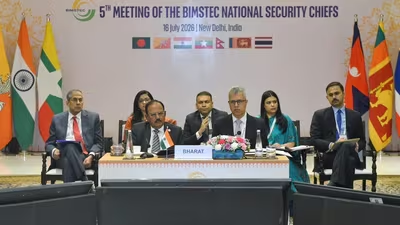
National security adviser (NSA) Ajit Doval on Thursday called for stronger regional cooperation among BIMSTEC member states to address emerging security challenges, saying the current global environment of conflicts, geopolitical uncertainty and technological disruptions demands collective action and “decisive actions” for the benefit of all member countries.
Event Context
Speaking at the fifth BIMSTEC national security advisers’ meeting, Doval said, “We are meeting today in the backdrop of a challenging global landscape. We are witnessing conflicts and geopolitical uncertainties. We are also facing multi-domain security threats, amplified by rapid technological advancements. Disruptions in global supply chains have also resulted in economic hardship for all our countries.”
“In this setting, there’s an urgent need for us to collaborate, take decisive actions for our mutual benefit, and find solutions to mutual discussions and deliberations to the vexed problems that we are all facing,” ANI news agency quoted Doval as saying.
Highlighting the importance of the Bay of Bengal grouping, Doval said BIMSTEC connects two of the world’s fastest-growing regions and represents nearly 1.7 billion people-around 22 per cent of the global population-with a combined GDP of about USD 5 trillion.
“We are united by the Bay of Bengal, not just geographically, but also through deep civilizational and cultural legacies that have evolved over a millennium of shared history,” he reportedly said.
The NSA said the grouping has strengthened cooperation across several security domains and made significant progress in tackling shared challenges. He said, “Building on these unique bonds, BIMSTEC has been anchored in robust cooperation across a range of sectors on the foundations of a great past. We strive to achieve a great future, sharing prosperity and resilience for all our people.”
“We have advanced and strengthened cooperation in fighting terrorism, combating transnational organised crime, cyber threats, meeting maritime challenges, and we are poised to combat new and emerging threats together,” Doval said.
Player Focus
He emphasised that BIMSTEC’s long-standing priorities of regional security, connectivity, capacity building and economic security should continue to shape the organisation’s future efforts. He said, “BIMSTEC’s long-standing goals of regional security, connectivity, capacity building, and economic security should continue to drive our collective efforts.”
Calling BIMSTEC a key pillar of India’s regional outreach, Doval said, “For India, BIMSTEC represents our vision of Neighbourhood First, our commitment to Act East Policy and the MAHASAGAR vision, which stands for Mutual and Holistic Advancement for Security and Growth Across Regions.”
Match Outlook
With BIMSTEC set to mark its 30th anniversary next year, Doval urged member countries to further strengthen cooperation and institutional capacity to enhance regional security and resilience.
source
“As BIMSTEC celebrates its 30th anniversary next year, let us commit to further expand our collaborative potential and infuse new energy and resources towards ensuring regional security. We aim to build institutional capacity and cooperation across our priority sectors,” he said.
Expressing confidence in the organisation’s future, Doval said the shared vision and trust among member nations would continue to produce meaningful outcomes.
“I am certain that our vision and common aspirations, coupled with mutual trust, will continue to result in tangible outcomes,” he said.
India is hosting the fifth BIMSTEC National Security Advisers’ Meeting in New Delhi.
The Bay of Bengal Initiative for Multi-Sectoral Technical and Economic Cooperation (BIMSTEC) was established on June 6, 1997, through the Bangkok Declaration. Initially launched as BIST-EC (Bangladesh-India-Sri Lanka-Thailand Economic Cooperation), the grouping expanded with Myanmar joining in December 1997, followed by Bhutan and Nepal in February 2004. It now comprises seven member states.
