
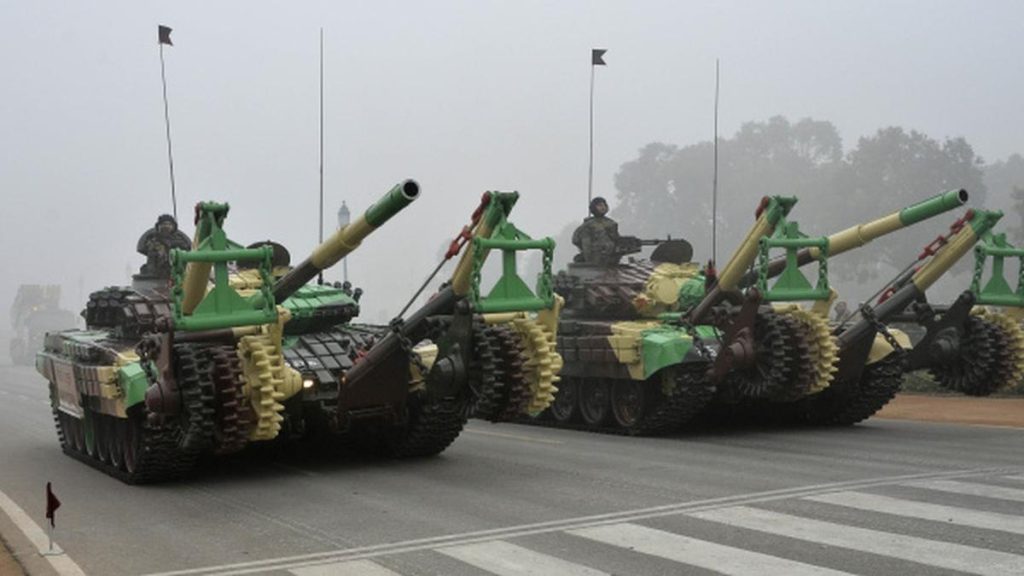
The Indian Army’s armoured fleet is set for a boost in maintenance and operational readiness with the creation of a new facility to overhaul T-72 and T-90 main battle tanks (MBTs) at Vehicle Factory, Jabalpur. Defence Minister Rajnath Singh performed the Bhoomi Pujan for the ₹472-crore T-Series Tanks Overhaul Project on August 27, marking another step towards strengthening indigenous capabilities for sustaining the Army’s Russian-origin armoured platforms.
Tank overhaul is essentially a comprehensive restoration and life-extension process for an MBT that has spent years in operational service. It is considerably more extensive than routine servicing or repair. The objective is to restore an ageing tank to a near-zero-hour and zero-kilometre state of operational readiness, allowing it to return to frontline service with its major systems inspected, repaired, replaced or revalidated. The process begins with stripping down the tank and removing its assemblies. Repairable assemblies are dismantled and inspected component by component. Components and assemblies that cannot be economically or technically repaired are replaced with new ones. Parts with limited shelf lives, including gaskets, seals, rings, bearings, fasteners and washers, are replaced. Major assemblies are then tested before being integrated back into the tank, followed by quality assurance checks. The overhaul also addresses the physical condition of the tank. Weld defects and worn-out portions of the hull are rectified, while rubber components and metal pipes are replaced or revalidated. Critical systems such as cooling, fuel, lubrication, air induction, exhaust and transmission systems are similarly examined and restored. In simple terms, overhaul is a process of taking an old but fundamentally usable tank, systematically examining its major components and restoring its combat-worthiness rather than replacing the entire platform. The Army operates these Russian-origin platforms across different operational environments, making their availability directly linked to combat preparedness. The addition of the Jabalpur facility will increase the country’s capacity to return overhauled tanks to the Army within the required timelines. A tank sitting in a maintenance facility is unavailable for operations; a tank successfully overhauled and returned to service restores an important combat asset to the force. The overhaul programme also assumes importance against the backdrop of India’s dependence on Russian-origin military equipment. Disruptions in international supply chains, particularly amid the continuing Russia-Ukraine conflict, have highlighted the vulnerability associated with dependence on foreign sources for spares and equipment. This makes indigenising components for Russian-origin platforms strategically important. The objective is not simply to manufacture a replacement part domestically, but to build the Indian industrial ecosystem capable of designing, producing, testing and supplying it reliably. The Ministry of Defence has been pursuing this through the Positive Indigenisation Lists (PILs) and the Srijan initiative. The Jabalpur overhaul facility could also become an important demand generator for the domestic defence industry. Tank overhaul requires hundreds of components spanning mechanical, electrical, electronic and hydraulic systems. This creates opportunities for MSMEs, start-ups and other Indian suppliers to participate in the supply chain. Local production of spares can reduce dependence on imports, shorten supply timelines and create a more resilient maintenance ecosystem. It can help develop an indigenous ecosystem for sustaining an entire family of armoured platforms. There is another important dimension. Extending the life of a tank does not necessarily mean keeping it technologically unchanged. Modern warfare is increasingly defined by the integration of tanks with infantry, artillery, drones, surveillance systems, air power and precision weapons. The battlefield has become more transparent, contested and networked. For this reason, the overhaul process provides an opportunity to incorporate modern sensors, improved communications, enhanced situational awareness and other capabilities where technically feasible. The Jabalpur project fits into India’s broader effort to reduce dependence on foreign sources for defence equipment and sustainment. For a large military such as the Indian Army, self-reliance is not limited to designing and manufacturing new weapons. It also means being able to maintain, repair, upgrade and extend the life of equipment already in service. The T-Series overhaul facility represents this less visible but strategically critical side of Aatmanirbhar Bharat .
The project, being implemented at Vehicle Factory Jabalpur, a unit of Armoured Vehicles Nigam Limited (AVNL), will have the capacity to overhaul 80 tanks annually. The remaining requirement is currently met by Heavy Vehicles Factory (HVF), Avadi, which has an annual overhaul capacity of around 150 tanks. The T-72 and T-90 form an important part of India’s armoured capability. HVF Avadi has supplied around 4,400 tanks to the Indian Army over four decades, highlighting the role of domestic facilities in sustaining India’s armoured fleet. The T-72, T-90 and BMP-II fleets require a steady supply of specialised spares, components and assemblies. By May 2026, five PILs covering 5,012 items of DPSUs had been notified, while more than 15,700 defence items, including 3,204 PIL items, had been indigenised through the Srijan Portal over the preceding five years.
Because the Army requires about 230 tanks to be overhauled every year, this is significant. For the Army, the significance is therefore not merely industrial. The project therefore has a significance beyond its annual capacity of 80 tanks. The future challenge will therefore be to ensure that an overhauled T-72 or T-90 is not merely mechanically restored but remains relevant to the changing battlefield.
