
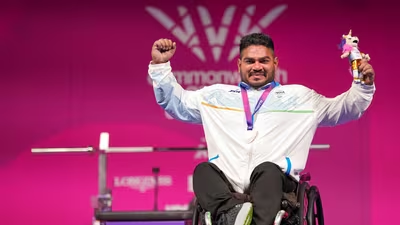
For years, Jhandu Kumar’s sporting ambitions had to coexist with a far more immediate concern: earning enough to keep his family going. There were vegetables to buy and sell, an e-rickshaw to drive, training expenses to somehow meet, and a body affected by childhood polio that he had already taught to compete rather than surrender.
Event Context
On Friday in Glasgow, all of those years converged on a Commonwealth Games podium. Jhandu won bronze in the men’s heavyweight para powerlifting event at the 2026 Commonwealth Games, producing a successful 190kg lift on his second attempt for 130.9 points. It was India’s first medal of the Games and came by the narrowest of margins, with the 29-year-old finishing just 0.1 point behind England’s Matthew Harding, who took silver.
Jhandu then went for 196kg on his final attempt, a lift that could have pushed him further up the standings, but he could not complete it. Nigeria’s Riluwan Idris took gold with 132.8 points.
Jhandu comes from Harnaut in Bihar’s Nalanda district and was affected by polio in childhood. His initial sporting path was not powerlifting at all. He competed in para athletics, including shot put and discus, before his increasing interest in strength training eventually steered him towards the bench.
Sport, though, had to fit around work. His family operated a vegetable shop in Harnaut Bazaar. Jhandu has recalled travelling around 20 kilometres to Bihar Sharif to purchase vegetables before returning home to sell them. Once work finished, usually by late afternoon, he would head to the gym to train.
The economics were unforgiving. The vegetable business could bring him only around ₹400-500 a day, while proper nutrition and supplements for serious strength training could cost far more. When construction work forced the shop to temporarily shut around 2021, he began driving an e-rickshaw to support the family.
The vehicle provided an income, but the long working hours inevitably came at the expense of training. Then came the decision that altered the direction of his life.
In 2023, Jhandu sold the e-rickshaw to finance his diet, travel and participation at the National Championships in Delhi. It was an enormous gamble for an athlete without financial security – and initially, it appeared to have failed.
Jhandu did not produce the result he wanted at the competition. But that disappointment brought him into contact with Rajinder Singh Rahelu, India’s bronze medallist in powerlifting at the 2004 Athens Paralympics. Rahelu recognised the potential that the result sheet did not show and helped Jhandu enter the Sports Authority of India’s National Centre of Excellence in Gandhinagar.
Also Read: Andrea Pirlo accepts Italy job as Azzurri entrust 2006 World Cup winner with long-term mission to revive national team
From there, his progress accelerated dramatically. At the 2023 Khelo India Para Games, Jhandu won silver in the 72kg category with a 157kg lift. A year later, he became the national champion with 187kg. In 2025, he lifted 205kg at the National Championships before improving the national record again to 206kg at the Khelo India Para Games.
International medals soon followed. He took bronze at the 2025 World Para Powerlifting World Cup in Beijing with a 192kg lift and added another bronze at the 2026 Asia-Oceania Open Championships in Bangkok. Before Glasgow, he had also spoken about lifting 210kg in training and made clear that the Los Angeles 2028 Paralympics remained his larger ambition.
Match Outlook
For Jhandu, however, simply standing on that podium carried a significance statistics could barely capture. “I feel as if I’m flying. This is my first medal,” he said after his event, an emotional reaction shaped by a sporting journey that began far removed from the security of India’s elite training system.
source
Glasgow, therefore, is not the end of Jhandu Kumar’s story. It is another marker in an extraordinary climb. The man who once sold his only source of livelihood just to afford the chance to compete has now won a Commonwealth Games medal for India. More importantly, the gamble that once left him with neither an e-rickshaw nor the national result he wanted ultimately opened the door to the career he had been chasing.
