
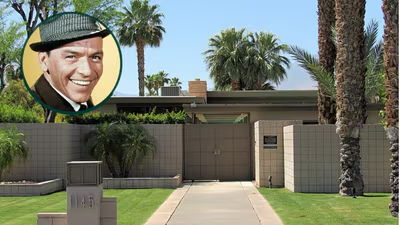
The house, which is called Twin Palms, was constructed in 1947 at the cost of $150,000 and became famous throughout California as a representative example of mid-century modern architecture. The Palm Springs house of Frank Sinatra was initially constructed as a retreat for him in the early years of his ascension to Hollywood stardom. It reflected a shift in American housing architecture after the end of the Second World War. The house incorporated luxury into its design and blended with the surrounding desert environment.
Stewart Williams designed the house at 1148 East Alejo Road in Palm Springs. The house was commissioned by Sinatra in 1947, when he was rising to fame as an entertainer. Sinatra spent $150,000 on this project, and its construction commenced amid tight deadlines.
This resulted in the completion of a house which was named Twin Palms due to two large palms planted near the swimming pool. What began as a celebrity’s desire for a private family residence eventually became an architectural landmark, attracting visitors interested in Sinatra’s life and the development of modernist design in the American West. On signing a profitable contract to appear in a film with Metro – Goldwyn-Mayer, he needed a place to spend the weekends with his family out of the bustling life in Hollywood. At first, he was attracted to the idea of building an authentic Georgian-style house, with a brick exterior and columns. But Williams, who had just started working on his first project in Palm Springs, came up with a different solution. He offered a design suited to the desert climate. Eventually the architect’s plans succeeded in persuading the famous singer. He desired his house to be ready by the time of a Christmas party, which left Williams and his construction crew with not much time before they had to build this house. One of the house’s distinctive feature was a swimming pool in the form of a grand piano. Built near the living room, it represented Sinatra’s desire to entertain his visitors. Another special feature of the house was the pergola and cabana, which provided an open-air setting, appropriate for Palm Springs’ climate. The house was not just a lavish celebrity home; it also exemplified a new architectural approach in postwar America.
Architect E, according to the Palm Springs Preservation Foundation .
