
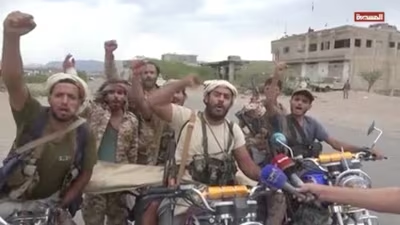
FOR MONTHS Saudi Arabia has talked up a possible new offensive against the Houthis, the Iran-backed rebels who control much of Yemen. Propagandists blustered that they might soon free Hodeida, the country’s main port, and perhaps even Sana’a, the capital.
The kingdom’s Yemeni allies promised they had “surprises” in store.
Days later, the Houthis announced a blockade on Saudi shipping through the Red Sea. This is the first test of the so-called Mecca alliance, a mutual-defence pact between Saudi Arabia, Turkey and Pakistan announced to great fanfare last month. At the same time, drones hit a major oil pipeline in Saudi Arabia, which carries up to 7m barrels per day (b/d) to the kingdom’s Red Sea ports. The Saudi foreign ministry blamed the attack on Iraqi militias, although the details are murky. Iran has spent months pressuring the Houthis to join the fray. In July Saudi jets bombed the airport in Sana’a to prevent the arrival of an Iranian plane carrying military advisers from the Islamic Revolutionary Guard Corps. They also resumed missile attacks on Saudi cities, which had been halted for several years. A return to serious fighting looked inevitable, and it was obvious that the Houthis would try to seize the coast. Yet when they did, the Saudis and their allies looked unprepared. More sober Saudi voices now argue that the kingdom needs foreign support. Yet it is unclear who might provide it. So far the kingdom’s new allies have sent nothing beyond well wishes. America has deployed advisers to help the Saudis with targeting and intelligence, but Donald Trump declined to launch his own air strikes despite personal entreaties from Muhammad bin Salman, the Saudi crown prince and the kingdom’s de facto ruler. Even if he changes his mind, America’s capabilities are strained. A prolonged campaign would probably require diverting one of two aircraft-carrier groups stationed near the Strait of Hormuz. That would undermine America’s blockade of Iranian ports, as well as its effort to escort oil tankers through the waterway, which has had some success of late. In the meantime, oil prices will probably head up. Saudi Aramco, the state-run oil giant, can probably repair the damaged pipeline quickly. A pumping station hit by an Iranian drone in April was fixed within days. But the risk of further attacks will remain.
Even before the latest offensive, Houthi threats were scaring vessels away from Bab al-Mandab: Saudi Arabia exported just 200,000 b/d through the strait in August, down from 4m b/d in June, according to Kpler, a data firm.
It was shut down “as a precautionary measure”. “The question quickly becomes whether outside powers can afford to remain spectators,” says Ali Shihabi, a commentator close to the royal court. “The Houthis called us, and they don’t want to fight,” the American president said on Saturday.
