
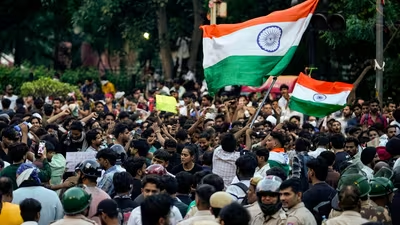
Prime Minister Narendra Modi has announced a proposed law to tackle examination paper leaks, alongside the setting up of fast-track courts for cases involving the offence. Elaborating on the proposed legislation, Union Law Minister Arjun Ram Meghwal said it would provide for faster investigations, day-to-day court hearings and time-bound justice for students affected by paper leak cases.
Centre renews call for Parliament debate
Alongside outlining the proposed legal measures, Meghwal appealed to Opposition parties to allow Parliament to function so that pending legislation could be taken up.
Also read | ‘A very exceptional thing’: Why Opposition wants to take up NEET paper leak in Parliament with an adjournment motion
On the demand for a discussion on paper leaks, he said Parliamentary Affairs Minister Kiren Rijiju had already conveyed the government’s willingness to debate the issue.
Details
The proposed measures follow a protest by the Cockroach Janta Party (CJP) at Jantar Mantar demanding the resignation of Union education minister Dharmendra Pradhan over the NEET paper leak.
The proposed draft law seeks to accelerate the legal process in paper leak cases by ensuring that pending matters are heard in specially designated fast-track courts, Arjun Ram Meghwal said.
Also read | PM Modi announces fast-track courts for paper leak cases: ‘Those harming youth won’t be spared’
Referring to the discussions held by the government on Thursday, Meghwal said the proposal reflects the Centre’s focus on delivering justice to young people affected by examination irregularities.
Also read | ‘Pathetic midnight video’: Opposition on PM Modi’s selfie message on paper leaks
“The decision taken by the Prime Minister yesterday that cases related to paper leaks pending in courts will be heard in specially designated fast-track courts is a significant one. This will involve day-to-day hearings, speedy trials, and time-bound investigations, which will provide justice to the youth. This is a major decision. In the same process, discussions continued all day yesterday,” he told news agency ANI.
The law minister said the proposed framework is intended to ensure that investigations are completed within a defined timeline and court proceedings move without unnecessary delays. He maintained that these measures would help deliver justice more quickly in paper leak cases.
“We would again request the opposition to allow the parliamentary proceedings to continue so that important bills can be discussed. If you want a discussion on paper leaks first, our Parliamentary Affairs Minister, Kiren Rijiju, has already said that we can discuss paper leaks first. Now, they are referring to rules, saying “do it on 267” in the Rajya Sabha, and they are stuck on “56” here. It’s a matter of discussion, so why are conditions being imposed? Discuss it, and do it in totality. How many states had paper leaks, what actions were taken, who were involved–discuss all of this. It will come before the country, and that’s what the government wants,” the law minister said.
Union Minister Bhupender Yadav also criticised the Opposition’s approach over the NEET issue, saying Parliament was the appropriate platform for a detailed discussion. He said the government had invited the Opposition for talks and urged it to avoid politicising the matter.
“I believe the Opposition should not resort to unnecessary politics, stir up excitement, and exploit circumstances for small political gains. Parliament is a major forum where a full discussion should take place,” Yadav said.
(With ANI inputs)
