
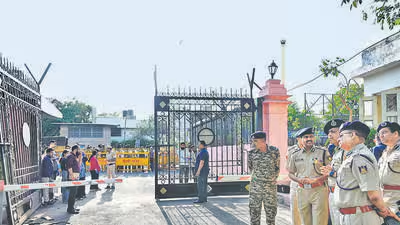
The Delhi Legislative Assembly is set to strengthen security across its premises with eight watchtowers, a dedicated patrolling track for the Central Reserve Police Force (CRPF), automatic sliding gates and an expanded surveillance network, the Assembly secretariat said on Monday. The overhaul follows repeated bomb threats and a security breach in April this year, when a car was driven into the Assembly complex.
The planned measures also include under-vehicle surveillance systems (UVSS), hydraulic blocking bollards, photographic identification at flap barriers, radio frequency identification (RFID) technology and additional CCTV cameras. One of the eight towers has been completed, and CRPF personnel will be deployed at the towers to monitor vulnerable areas and respond to suspicious activity. A dedicated track is also being developed to enable CRPF personnel to patrol the Assembly boundary. Hydraulic blocking bollards have also been put in place at sensitive entry points to prevent unauthorised vehicles from entering the complex. An RFID system will help identify and record vehicles entering the premises, enabling more systematic monitoring of vehicular movement. A digital management system has also been installed at the reception to streamline visitor registration and verification. It records photographic identification and relevant details, including the purpose of a visit, to strengthen entry management and accountability. The security overhaul follows an incident in April when a man allegedly rammed his car through the Assembly’s security barriers and drove into the premises, raising questions about access controls. The complex has also received a series of bomb threats, many of which have turned out to be hoaxes, prompting heightened security and checks.
Around 70% of the work has been completed, Gupta said, adding that the track would improve perimeter monitoring and allow security personnel to respond more efficiently to potential threats. Automatic sliding doors are being installed at Gates 1 to 5 to improve access regulation. UVSS equipment has been installed at Gates 2 and 5 to inspect vehicles entering the premises. At Gate 1, flap barriers equipped with photographic identification facilities are being installed to strengthen the verification of visitors and maintain entry records. The Assembly currently has around 120 CCTV cameras.
Assembly speaker Vijender Gupta said the measures were intended to improve perimeter security, regulate access and enable a faster response to potential threats. “Eight watchtowers are being established at strategically identified locations across the front and rear sides of the Assembly complex, including behind the reception, to strengthen perimeter surveillance,” Gupta said. The systems will help identify suspicious vehicles and flag potentially fraudulent number plates for further verification by security personnel, Gupta said. Delhi Police has been asked to identify additional blind spots and vulnerable locations where cameras can be installed to plug surveillance gaps, officials said. Gupta said the measures would combine physical security infrastructure, vehicle screening, digital identification, CCTV surveillance and improved patrolling to protect legislators, officers, staff and visitors. The Assembly secretariat said the measures were aimed at strengthening preventive security and enabling early detection of potential threats across the complex.
