
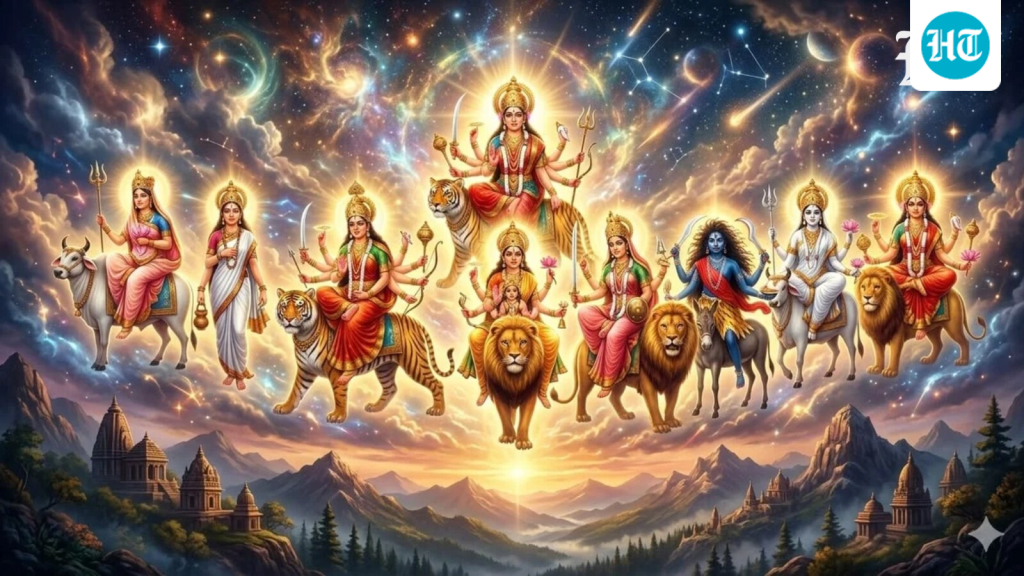
During Navratri, the presence of the Goddess can be felt almost everywhere. She appears in temple queues, fasting rituals, garba circles, evening prayers and beautifully decorated pandals. But alongside devotion, another emotion often finds its way into spiritual practices: fear. Fear of negative energies, curses, planets, spirits, or doing a ritual incorrectly can sometimes become so strong that it overshadows the deeper meaning of faith.
Somewhere along the way, spirituality can quietly turn into superstition. This is where it may help to pause and look at what these traditions are actually trying to teach. What if Tantra was never meant to make you more afraid of the Divine? Dr Manmit Kumarr, Spiritual Guru and Founder of the Academy of Tantra, explains the deeper meaning of Shakti, fear and spiritual practice. The word Tantra is often surrounded by misunderstanding. For many people, it immediately brings to mind black magic, supernatural powers or secret rituals. However, the Tantric traditions of India are far more complex. Shakta Tantra places Shakti, the Divine Feminine Power, at the center of spiritual life and engages with the full range of human experience. That includes not only what feels comfortable, pure or socially acceptable, but also desire, fear, death, attachment, anger, loss and the parts of ourselves we may prefer not to face. The Divine Mother can be nurturing and fierce at the same time. This many-sided nature of Hindu goddess traditions has been explored extensively in religious and cultural scholarship. It is a path of transformation. Shakti is not meant to make you smaller or more fearful. She is meant to awaken something within you. Transformation is rarely comfortable, and that is one reason Tantra can appear frightening from the outside. Consider Maa Kali. Her dark appearance, garland of heads, cremation-ground imagery and outstretched tongue can seem terrifying to someone unfamiliar with the symbolism. But Kali is associated with kāla, a Sanskrit word connected with both time and death. Her imagery can be understood as an invitation to confront ego, attachment and the belief that you can control life forever. The mistake is to look at this imagery and conclude, “She is dangerous. A deeper question is, “What am I afraid to face? That shift in perspective can change the way you understand the Goddess and your own fears. Tantra does not necessarily ask you to become fearless. Instead, it asks you to become conscious of your fear. There is an important difference between the two. Pretending that you are not afraid does not automatically make you courageous. Courage can mean acknowledging that you are afraid and still finding the strength to face what needs to be faced. That is one way to understand Shakti. You can ask the Mother to protect you from difficult situations, but you can also ask for the strength to meet whatever life places in front of you. It asks you to become stronger while facing them. Shakti is not an escape from responsibility. This is one of the most important ideas for a modern spiritual seeker to understand. Your spiritual practice should not become a reason to avoid taking action. If you are in an unhealthy relationship, lighting a diya does not remove the need for an honest conversation. If you are financially irresponsible, a prosperity ritual cannot replace discipline. If you are dealing with a health concern, spiritual practice should not become a reason to ignore appropriate medical care. Shakti does not absolve you of responsibility. Instead, it can give you the courage to take responsibility for your choices.
Tantra, therefore, cannot simply be reduced to a collection of powerful remedies. Because it does not simply ask for problems to disappear, the second prayer can be much deeper.
Similarly, if you repeatedly hurt other people and then perform a ritual to remove “negative energy,” the ritual cannot replace accountability.
Because strength does not require you to become hard, compassion is also Shakti. Because she protects, gentle because she nurtures and compassionate because she sees beyond temporary identities, durga is fierce. What do you need to release so that something new can begin?
A more grounded approach is to pray, practise, listen and then act. You live in a time of extraordinary external power. Technology gives you access to information almost instantly. You can communicate with people across continents and build careers, businesses and communities at a remarkable pace. Yet greater external power does not always mean greater inner stability. You may still struggle with anxiety, decision fatigue, difficult relationship patterns, burnout, fear of uncertainty, a constant need for validation or the inability to sit quietly with yourself. You may know more than ever and still find it difficult to let go. Perhaps what you need is not always more information, but greater inner capacity. This is where a more mature engagement with Shakti can become meaningful. Instead of using spirituality only to find answers or remedies, you can use it to develop awareness, courage, and emotional strength. Courage is Shakti, but not in the sense of aggression or constantly trying to prove that you are stronger than everyone else. It can be the courage to say no, leave what is damaging, begin again, admit when you were wrong, ask for help, sit with uncertainty and love without losing yourself. The Devī Māhātmya brings these qualities together, presenting destruction as part of the restoration of order. Real Shakti does not make you cruel. It can help you protect without hatred, say no without guilt and act without constantly waiting for someone else’s approval. When you approach spirituality, it can be tempting to look for certainty. Which ritual will remove this problem? Which mantra will guarantee the result? Who is causing the negative energy? What remedy will make everything right? But the deeper spiritual traditions do not always offer certainty. Sometimes they offer something more useful: clarity. When you become clearer, you may stop blaming everyone else, handing over every decision to external forces, or allowing fear to control your life. You begin to participate in your own life more consciously. That is an important shift. Spirituality becomes less about finding someone or something to blame and more about understanding yourself. This Navratri, you can light the diya, chant your mantra, fast if it suits you and celebrate the Mother. But you can also turn inward and ask yourself a few honest questions. Where do you need more courage? Where have you abandoned yourself? Where is fear making your decisions? Where have you mistaken control for strength? This is where ritual can begin to become sadhana, a deeper spiritual practice. The real question is not simply whether you believe in Shakti. It is whether you can live in a way that honors what Shakti represents. Can you stand up or walk away when necessary? Can you serve without constantly seeking praise? Can you hold power without misusing it? Can you face your own darkness without projecting it onto someone else? Can you remain kind without becoming powerless? That balance may be one of Tantra’s most important lessons. The Divine Mother does not ask you to become less human. She asks you to understand what it means to be human with greater awareness. So this Navratri, do not look for the Goddess only outside yourself. Look for her in your choices, your courage, your compassion and the way you respond when life becomes difficult. When Shakti is truly awakened, fear no longer has to be your master. Awareness can be. Disclaimer: Spiritual and Tantric traditions can be understood in different ways, and the views expressed here reflect a spiritual perspective rather than established scientific fact. This article is intended for reflection and general awareness and should not replace professional medical, financial or other expert advice.
The belief that “the Goddess will fix everything” can miss the relationship between spiritual practice and everyday life.
