
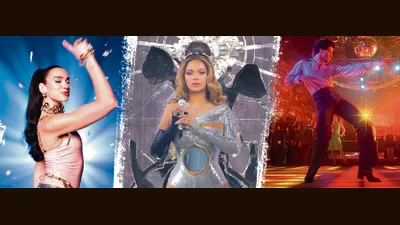
On the evening of July 12, 1979, a large crate full of disco records exploded in the centre of Chicago’s Comiskey Park stadium.
Event Context
Retro Indian tracks are being rereleased by archival labels such as the Los Angeles-based Naya Beat, being spun at bars and clubs, and appearing on the soundtracks of blockbuster films such as this year’s Dhurandhar: The Revenge (Usha Uthup’s Ramba Ho) and TV shows such as Bait, whose soundtrack blends UK dance and hip-hop music with retro tracks from South Asia and the UK.
BOOGIE WONDERLAND
Born in the warehouses and underground clubs of early-1970s New York, disco was more a social experiment than a specific musical sound.
The John Travolta-starrer Saturday Night Fever played an interesting role in that arc. Released in 1977, it earned over $237 million worldwide and turned what had been an underground subculture into a global phenomenon, but it also flattened disco into a caricature of mirror balls, polyester suits and clownish moves, erasing much of its Black, Latino and queer roots.
Meanwhile, the genre was dominating the charts, generating millions of dollars in revenue. Gloria Gaynor’s I Will Survive and Village People’s YMCA (both 1978), for instance, sold over 12 million copies each.
As more of this music flooded the market, critics lashed out. Disco was called “formulaic” and “soulless”. But historians argue that the root of the anger ran far deeper, reflecting anxieties around race, sexuality and changing ideas of masculinity.
Then came Comiskey Park and, after that, labels were wary; artists moved on.
STAYIN’ ALIVE
The genre didn’t die, though. It retreated to the underground spaces where it was born.
In Chicago, DJs such as Frankie Knuckles distilled disco’s grooves into what would become house music (a genre he famously called “disco’s revenge”).
Across New York, Paradise Garage and The Loft continued to nurture dance culture. The genre’s rhythmic DNA seeped into house, boogie, garage, and eventually electronic dance music.
“Disco has influenced so much contemporary Black American music,” says Raghav Mani, a DJ and founder of Naya Beat Records. “It may have gone through these peaks and valleys, but the soul and heart of it remained very much alive.”
The so-called disco crash, in fact, was a largely American story. Elsewhere, Europe embraced the synth-driven evolution called Euro-disco. In Japan, the sound fused with jazz, rock and funk to give rise to city pop.
Nigeria and Ghana folded it into Afro-funk and highlife. Across the Caribbean, it collided with soca and calypso. Rather than disappearing, disco became a global musical language, reshaped by local musicians into countless regional dialects.
India’s story sits comfortably within that history.
Here too, films that couldn’t see beyond the disco ball would promote absurd stereotypes. But alongside, Bangalore-born producer Biddu would help invent Euro-disco in Britain, producing Jamaican-British artist Carl Douglas’s Kung Fu Fighting (1974) before returning to South Asia for Aap Jaisa Koi (1979) and Nazia Hassan’s Disco Deewane (1981).
“Listen to Ilaiyaraaja’s music from the late ’70s and early ’80s, and one can really hear how Indians made this art form our own,” says actor and musician Imaad Shah, one half of Mumbai’s nu-disco duo Madboy/Mink. “It’s a mutant version of disco, but it’s very much Indian.”
Ironically, as disco continued to influence dance music, R&B and pop, the word itself became unfashionable.
TRACK CHANGES
So what changed?
The revival can be traced, at least chronologically, to electronic duo Daft Punk’s smash hit Get Lucky, a breezy disco-pop track that reached #2 on the Billboard Hot 100 list in 2013.
Alongside, over the past decade, nu-disco bands such as the Belgian Soulwax and Aeroplane have helped the genre break out of the dance-music underground and get back onto the charts. Nu-disco proponents have found work producing for artists such as Lady Gaga and Robin Thicke, nudging the sound of contemporary pop towards funk and disco.
The early 2020s, particularly the pandemic years, saw a number of disco-affiliated albums become smash successes, including Dua Lipa’s Future Nostalgia (2020), Roisin Murphy’s Roisin Machine (2020) and Beyonce’s Renaissance (2022). Inspired, record collectors, DJs and reissue labels began to excavate forgotten disco scenes from India, Pakistan, Trinidad, Nigeria and Japan, among other countries, to reframe the genre not as a kitschy relic but as a genuine global movement that lived on.
The revival was now a fixture on the dance floor. And contemporary filmmakers and storytellers began to deploy disco as emotional shorthand: for glamour, longing, identity, nostalgia, liberation, or collective joy, benefiting each time from the genre’s undeniable sense of propulsion.
Team Analysis
The event was part of a backlash gathering steam across the US.
Many called July 12 “the day disco died”.
In July 2026, that obituary looks wildly premature.
Disco has quietly slipped back into the mainstream.
Its syncopated basslines underpin chart-topping tunes by Dua Lipa (the ’70s-inspired Dance the Night, among others), Tyler, The Creator (Sugar on my Tongue; which owes a lot to Italo-disco and funk) and Beyoncé (Cuff It and Summer Renaissance, among others).
Its sound united Black, Latino and queer communities, as well as artists, immigrants and working-class New Yorkers. On the dance floors of parties such as DJ David Mancuso’s The Loft, many of the hierarchies that governed life outside momentarily dissolved.
“Race, color, belief and sex were minor details in the dance,” Michael Gomes, a writer and a regular at the Loft parties, told historian Tim Lawrence in the latter’s 2003 book, Love Saves the Day: A History of American Dance Music Culture, 1970-1979. “What was important was can you get down?”
That vision of the dancefloor helps explain both disco’s explosive rise and the vehemence of the backlash against it.
Match Outlook
“I think the sound represents a more hopeful bygone era,” says Mani. “When people could come together as a community. When the future felt brighter.”
It is also still simply great music that seems to suit every scene.
