
New Delhi:
Latest Update
The latest disruption has also renewed attention on the long-pending issue of maintenance of the canal. Although around 20km of the Munak canal lies within Delhi, it continues to be maintained by the Haryana irrigation department under an existing arrangement.
“There has been no progress in handing over maintenance of the Delhi stretch to the Delhi government. Haryana continues to manage both the canal and the land along it. DJB will fund strengthening of the canal lining, and a DPR is being prepared to prevent such breaches in future,” a senior Delhi Jal Board (DJB) official said.
Details
Four days after a leak in the Munak canal disrupted Delhi’s water supply, residents in several parts of the Capital continued to face erratic supply on Monday, with some localities also reporting contaminated water. While officials said the breach has been repaired and supply is gradually returning to normal, the latest disruption has again highlighted the fragile condition of Delhi’s most critical raw water lifeline.
The latest incident marks at least the fourth breach or major damage to the Munak canal system in recent years, reinforcing concerns over the upkeep of the infrastructure that carries the largest share of Delhi’s water from Haryana.
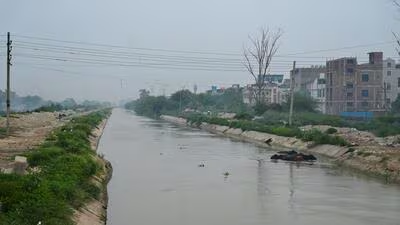
According to a government official, who asked not to be identified, the disruption began on Friday after a leak developed in the wall of the Carrier Lined Channel (CLC) near Bawana. The CLC is one of two parallel channels that make up the Munak system, the other being the Delhi Sub-Branch (DSB). The canal normally carries around 719 cusecs of raw water to Delhi, but following the breach, inflow through the CLC dropped to just 92 cusecs, forcing authorities to divert part of the supply through the DSB canal.
Although repairs were completed on Friday itself, officials said it has taken three to four days to restore reservoir levels and normal distribution across the network.
Residents in Rohini, Raj Nagar, Palam, Inderpuri and adjoining areas, however, said water supply remained disrupted on Monday. “Our lane in Sadh Nagar has received no water for four days. There has been no response from the Delhi Jal Board to our complaints,” said Dharamveer Yadav, a resident of Palam.
Residents of Rohini Sector 3 also reported prolonged supply cuts, while Jyotika Bhati from Inderpuri said EF Block had not received water for three days. “We have been repeatedly assured that supply will be restored, but nothing has happened. At least water tankers should be sent,” she said.
The Munak canal has witnessed repeated failures in recent years. In July 2024, a 40-foot section of the Delhi Sub-Branch canal collapsed near Bawana, inundating nearby settlements and disrupting water supply across northwest and west Delhi. That was the third major breach in two years, following similar incidents in June and October 2023. Additional breaches have also been reported near Barwasni village in Sonipat.
The 102km-long canal carries nearly 37% of Delhi’s raw water through the CLC and DSB channels before reaching the Haiderpur water treatment plant. Any disruption directly affects treatment capacity and water supply across large parts of the Capital.
Spot checks by HT have previously found damaged concrete lining, cracks, overgrown vegetation and encroachments along sections of the canal. A DJB report submitted to the Delhi Assembly last year also highlighted transmission losses of nearly 30% along the DSB canal, compared with around 5% in the CLC.
The Delhi government has proposed taking over maintenance of the canal stretch within the Capital. Besides strengthening the lining, it has also announced plans to install solar panels over portions of the canal, build protective boundary walls and develop an elevated corridor above it to improve connectivity in outer Delhi.
HT tried to contact the Haryana Irrigation deptartment, but got no response.
