
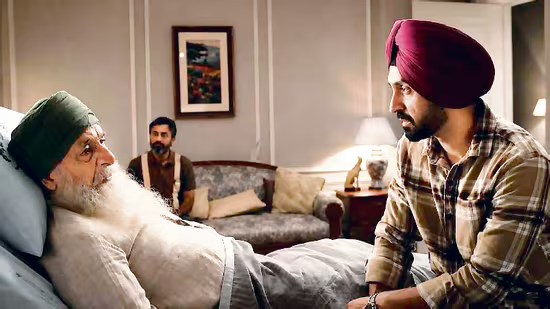
The success of the Hindi film Main Vaapas Aaunga, now in theatres, featuring Naseeruddin Shah and Diljit Dosanjh, has everyone talking about Partition-era literature again. Familiar names have resurfaced, chief among them that of the iconic Saadat Hasan Manto.
Event Context
In my previous column, I mentioned Phanishwar Nath Renu (1921 – 1977), the writer from Purnea in Bihar, whose short story Maare Gaye Gulfam was made into the film Teesri Kasam (1966), about a bullock cart rider who falls in love with a travelling nautanki dancer.
He is not a writer one associates with Partition. He is a chronicler of rural Bihar. And yet, when I read his best-known novel, Maila Anchal (1954), I was moved by the story of one of his characters, and I want to recount it here.
Maila Anchal is set in the 1940s, in a village in Purnea steeped in illiteracy, superstition and caste divisions. But change is coming, slowly and inevitably, to Meriganj.
Even in this remote hamlet, villagers know of “Gandhi mahatma”. There is a Congress outpost in Purnea, the Socialist party is making its presence felt, and a right-wing group in black topis is becoming active. But the Mahatma’s aura is unmatched.
The village’s most ardent devotee is a person with dwarfism named Bavandas, who is to me the most heroic character in the novel.
During the Quit India movement of 1942, as a crowd tries to unfurl the tricolour in a courtroom, the police arrive and begin to fire shots in the air. Bavandas makes his way through the legs of the policemen and plants the flag, shouting, “Mahatma Gandhi ki jai!” He is arrested and goes to jail.
Bavandas has corresponded with Gandhi. He has met leaders such as Jawaharlal Nehru and Rajendra Prasad. He delivers speeches in his big, booming voice. He holds himself to Gandhian ideals, and fasts in penance when he fails to live up to them.
Then, on January 30, 1948, Gandhi is assassinated. Villagers listen as Nehru announces the news on the radio, tears in his voice.
The village is in shock, but Bavandas is devastated. He has no hope left, and decides to leave. He pulls a small packet from his jhola, which contains his correspondence with Gandhi. He looks at the letters one by one, as if for the last time, then gives the packet to a friend and fellow Gandhian, and asks him to hand them over to a senior Congress leader.
He catches a train headed east, to Kalimuddinpur, then walks to the banks of the Nagar River that flows through India and East Pakistan, like a border between the two.
It is freezing cold. Bavandas has received a tip that dozens of bullock carts will come this way, loaded with smuggled goods such as garments, sugar and cement. They belong to Dularchand Kapra, a man who ran gambling dens and trafficked in women, drugs and alcohol (Bavandas had picketed his shops), and has lately morphed into a neta.
Jhola on his shoulder, Bavandas stands in the middle of the path. He prays to Bapu for strength. The carts are coming. There are about 50 of them. Seeing him, they come to a messy halt. The local policeman calls out “Kaun hai?”
“Hum hain,” he says.
The policeman is stunned. He knows Bavandas, and tries to get him to move. He refuses.
The policeman runs to a nearby bungalow where the gangster-turned-neta, a hawaldar and the supply inspector are partying. He tells them what has happened.
Is Bavandas alone, they ask.
“Yes. He’s refusing to move.”
Instructions are given: Let the bullock carts continue.
But the animals refuse to budge. Kapra and the havaldar have to twist their tails to force them forward. Bavandas is knocked down and crushed.
Team Analysis
The killers throw his bloodied body onto the Pakistan bank of the river. On a routine patrol that afternoon, Pakistani policemen find the body and recognise it: This is the little man from the other side! He doesn’t belong here.
The corpse is picked up, thrown into the river and vanishes.
But the jhola, hung on a tree on the Indian bank, is so distinctive that Kapra identifies it immediately. As he rips it off its branch, a fragment of cloth remains.
Not long after, as devotees flock to Gandhi’s memorial in Delhi, at Kalimuddin Ghat, an unnamed woman, sad and weary, sees the cloth and thinks it indicates a chithiari pir or a tree regarded as a saint, to whom one must offers scraps of cloth as tribute. She tears a piece from the anchal of her sari, ties it to the tree, makes a wish and leaves.
Months go by. On Kalimuddin Ghat, another piece of cloth appears.
(Email Poonam Saxena on poonamsaxena3555@ gmail.com. The views expressed are personal)
