
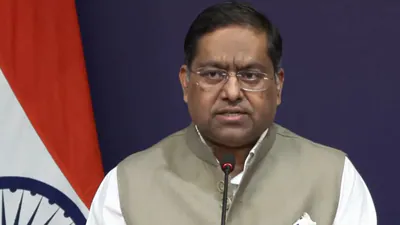
The Indian Ministry of External Affairs (MEA) on Friday asserted that New Delhi, not Beijing, is the party with legitimate sovereignty concerns over occupation of territories. This comes just days after foreign minister S Jaishankar’s meeting with his Chinese counterpart, Wang Yi, in Manila.
Event Context
“When it comes to sovereignty issues, it is actually India that should be and is raising them,” MEA Spokesperson Randhir Jaiswal said at a press briefing, apparently replying to a question.
“India does not violate China’s sovereignty in any manner and has been consistent,” Jaiswal said.
He added that China has been “in illegal occupation of Indian territories in Jammu & Kashmir and Ladakh since 1963”, and India’s right over that is “officially acknowledged even by China”.
He added that Chinese projects exist on land in J&K that belongs to India and “we object to that”.
Team Analysis
MEA spokesperson Jaiswal’s remarks underscored that the position is not one-sided.
New Delhi has repeatedly objected to the 1963 Sino-Pakistan boundary agreement, under which Pakistan ceded roughly 5,180 sq km to China — a pact India has called “illegal and invalid” and has never recognised.
The MEA has separately objected to Chinese infrastructure activity in the region and to projects under the China-Pakistan Economic Corridor (CPEC), which it says pass through Indian territory under Pakistan’s forcible and illegal occupation.
The MEA has also protested Beijing’s creation of new counties in Xinjiang whose jurisdiction extends into parts of Ladakh’s Aksai Chin, telling China through diplomatic channels that “India has never accepted the illegal Chinese occupation of Indian territory in this area”.
A separate row over China’s renaming of locations in Arunachal Pradesh as part of ‘Zangnan’ surfaced earlier this year, with the MEA calling it an attempt to manufacture “baseless narratives”.
Beijing’s position is that the Jammu and Kashmir question is “left over from history” and should be resolved under the UN Charter and relevant Security Council resolutions. India maintains that J&K and Ladakh are “integral and inalienable” parts of India on which no third country has the standing to comment.
India and China continue incremental steps toward normalisation, including resumed direct flights, an updated visa regime, the restarting of the Kailash Manasarovar Yatra, and renewed border trade, even as both sides continue to spar over territorial claims along the Line of Actual Control and beyond.
The reset in relations happened as the US under Donald Trump took a combative line and imposed massive trade tariffs on India, China and other countries.
source
This follows Jaishankar’s meeting with Wang Yi on July 22 on the sidelines of the East Asia Summit and ASEAN Regional Forum in Manila, during which, according to a report of the Chinese official news agency Xinhua, the Indian minister said India’s positions on Taiwan and Xizang remain unchanged and that India respects China’s sovereignty. Jaishankar also called the normalisation of ties, underway since the October 2024 Narendra Modi-Xi Jinping meeting in Kazan and reaffirmed at Tianjin last August, a gradual process, it reported. He reportedly flagged market access and trade balance as unresolved issues.
