
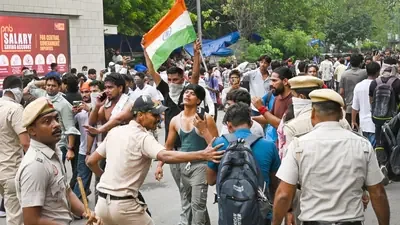
Massive protests inside and outside Parliament rocked the first day of the monsoon session on Monday as a phalanx of agitators marched in central Delhi demanding the resignation of Union education minister Dharmendra Pradhan and the Opposition sought to corner the government over repeated paper leaks and exam irregularities inside the House.
Event Context
The 23-day-old sit-in hunger strike at Jantar Mantar snowballed into one of the largest disruptive protests in recent years as tens of thousands of people marched to Parliament, braving police batons, tear gas and scores of barricades that turned central Delhi into a gridlock and triggered snarls across the Capital.
In his customary speech before the session, Prime Minister Narendra Modi highlighted the achievements of India’s young people. “Young people aged 28 have planted the nation’s flag in space. This sends a powerful message regarding the potential and aspirations of our country’s youth,” the PM said, referring to Skyroot Aerospace’s maiden orbital launch of Vikram-1, India’s first privately developed launch vehicle.
Also Read | Lathis, tears, barricades: How CJP march was halted by police | Ground Report
Meanwhile, around 1.30pm, a swarm of protesters toppled barricades to advance deeper into Lutyens Delhi and march to Parliament, just over a kilometre away from Jantar Mantar, The Central Industrial Security Force (CISF) sealed the gates of the complex –– for the first time since the 2001 Parliament attack –– and commandos took up positions with automatic weapons, sparking a controversy.
Delhi Police said the planned but unauthorised march to Parliament was handled “professionally” but visuals showed several young unarmed protesters being thrashed by security personnel in full riot gear.
Born out of a controversial remark by Chief Justice of India Surya Kant earlier this year, the Cockroach Janata Party first garnered millions of followers on social media before launching a sit-in protest on June 6 demanding the resignation of Pradhan over repeated question paper leaks. After days of tepid crowds, the movement was galvanised by the hunger strike and forcible removal of activist Sonam Wangchuk last week.
Crowds swelled through the weekend and by Monday morning, columns of people – many of them students, first-time agitators and young professionals – had defied a steady monsoon drizzle and heavy police barricading to join what is the first public protest in Modi’s third term.
Also Read | ‘Lied to family, faced lathis here’: Young women at CJP march recount experience, ‘like cockroaches, we’ll return’
Officials admitted that they had underestimated the strength of the gathering and put it at about 35,000, but protesters and eyewitnesses said the number was at least twice as much. Roughly 2,000 police personnel and 20 companies of paramilitary forces were deployed.
It added that 15-20 government vehicles and property were vandalised and around 70 protesters detained.
In the afternoon, Union minister JP Nadda met two CJP representatives, who submitted a written memorandum demanding the resignation of Pradhan, among other things.
Player Focus
“This morning, for the first time, a proposal came from the protesters to hold talks with the government, and our discussions have been ongoing since 11.50am. The meeting took place in a cordial atmosphere. An initial verbal discussion was held in detail with their delegation, and they submitted a written petition to me around 4pm. I have requested all the protesters to end their sit-in and assist the administration in restoring normalcy,” Nadda wrote on X.
CJP spokesperson Saurav Das, who was one of the two people meeting the minister, said Nadda had assured them he would discuss the demands internally. “However, no commitments have been made so far. The peaceful protesters will not rest until the demand is met!” he posted on X.
Leaders in the Union government claimed that the stir was politically motivated. “The protests are over…The real students have gone back to studying. Fresh examinations (NEET) have already been conducted and the students are in the process of securing admissions. Those who are carrying on with the protests are political (people) who want power,” said a senior BJP leader, requesting anonymity. He reiterated that there was “no assurance given to the CJP to meet their demands.”
But the Opposition flayed the government.
“This country has the majority of young people, PM Modi is the most anti youth Prime Minister India has ever had. The boys and girls who are walking the streets of Delhi are not criminals. They are demanding their rights. Their rights are to have an education system that respects them, to have an education system that is fair, to have an education system that is working. There’s absolutely nothing wrong in what they are doing and it’s disgusting what the government is doing and what the police is doing,” leader of the Opposition in the Lok Sabha Gandhi said in a message after Parliament was adjourned.
Samajwadi Party MP Dimple Yadav marched from Parliament to Jantar Mantar. “The situation across the country is such that the youth want to voice their concerns, yet the government refuses to listen or engage in dialogue. Students have repeatedly stated this, and Sonam Wangchuk has also urged the government to open a dialogue. However, the government is so rigid and callous that it refuses to heed anyone else’s views,” she told reporters.
Match Outlook
“I am firmly convinced that where there are facts and logic, there is no room for a storm,” he added. “…I am not speaking of a 56-year-old youth here,” he said in an oblique reference to Congress lawmaker Rahul Gandhi. Modi also hoped for a productive monsoon session of Parliament, “where every viewpoint will be respected”.
Also Read | Protesters were ‘unruly, aggressive and violent’: Delhi Police on CJP protest
But as soon as the Houses convened, the Opposition sought to turn the tables on the government over paper leaks and student protests. Leader of the Opposition in the Rajya Sabha Mallikarjun Kharge accused the government of suppressing the protests at Jantar Mantar.
“I am talking about the future of lakhs of students. For that, today, thousands of children have come to Jantar Mantar. There a lathi-charge has taken place. The government is trying to hurt them; the government is trying to suppress them,” said Kharge.
On X, Kharge alleged that the government was suppressing the voice of the youth. “90 paper leaks have occurred, the futures of millions of students have been ruined, 20 children have taken their own lives due to the NEET paper leak, families have been devastated… But the education minister of the Modi government, Dharmendra Pradhan, is clinging to his chair,” he posted.
Eventually, the Lok Sabha was adjourned seven times and the Rajya Sabha six. Amid the din, only a bill to raise the number of Supreme Court judges could be tabled in the Lok Sabha.
Throughout the day, central Delhi reverberated with the booming sound of tear gas shells fired at protesters; police said the agitators turned violent and pelted stones. Delhi Police said 118 personnel, including senior officers, were wounded. The exact number of injured protesters was not immediately known. However, reports said the wounded could be in the hundreds — with officials at one government hospital confirming “at least 100” protesters being treated for injuries. The police put the number of injured protesters at 60.
“The protesters displayed unruly, aggressive and violent behaviour. Despite repeated warnings and lawful directions issued by the police, they refused to disperse and deliberately violated the prohibitory orders in force. The protesters attacked police personnel with stones and other objects, attempted to breach police barricades, vandalised police and other government vehicles, damaged public property, and resorted to large-scale violence,” a police statement said.
