
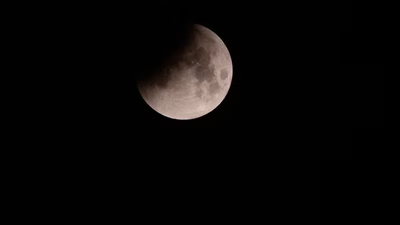
The August 28, 2026 lunar eclipse, or Chandra Grahan, will bring a striking celestial event for skywatchers in several parts of the world. But if you are in India, there is one important point to know, skywatchers will not be able to see the eclipse from the country.
Why will the Moon appear reddish?
NASA places the greatest eclipse at 4:13 a.m. UTC, when about 96.3% of the Moon will be inside Earth’s umbral shadow. Because the Moon will be below the horizon during the event, space.com also notes that observers in India will miss the eclipse.
The deep partial lunar eclipse will occur as the Moon passes through Earth’s shadow. The eclipse also occurs during the Full Moon and coincides with Raksha Bandhan i n India, prompting questions about its timing, visibility, Sutak, and significance in astrology. NASA’s eclipse information shows that the event will be visible from parts of the Americas, Europe and Africa. For Indian readers, this means you will not see the Moon darken or develop the reddish colour associated with a lunar eclipse. A lunar eclipse occurs when Earth comes between the Sun and Moon and blocks direct sunlight from reaching the lunar surface. Some sunlight still passes through Earth’s atmosphere. NASA explains that Earth’s atmosphere filters the light, allowing more red and orange wavelengths to reach the Moon. This can give the eclipsed Moon a copper or reddish appearance.
Nearly the entire lunar disk will enter Earth’s darker central shadow during the event, according to NASA.
