
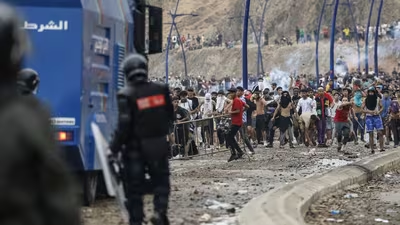
The death toll from the unprecedented migrant rush into Spain’s North African enclave of Ceuta has risen to 57, with authorities recovering the bodies on the Spanish side of the border as the government said it had largely reversed the mass crossings that saw tens of thousands of people enter the territory.
Event Context
Migrants returning from Ceuta, says Spain
Spain’s government representative in Ceuta said 57 bodies had been recovered on the Spanish side of the border, Reuters reported. There could be additional casualties on the Moroccan side.
Officials said some migrants drowned while others were crushed as they attempted to climb the breakwater supporting the border fence.
Also Read: A ruling, a rumour, a rush: What happened before thousands crossed into Spain’s Ceuta enclave from Morocco
Spain said most of the more than 50,000 people who crossed into Ceuta by land and sea had already returned voluntarily. The Spanish Interior Ministry estimated that around 37,500 migrants had gone back after crossing since Thursday morning, while Ceuta regional government chief Juan Jesus Vivas said as many as 60,000 people had entered the enclave over the past couple of days.
Moroccan riot police using batons, tear gas and water cannon to disperse crowds attempting to reach Ceuta, the report added. Burnt-out vehicles, including a bus and seven cars, were seen following clashes near the frontier. On the Spanish side, military vehicles were deployed along sections of the border as migrants gathered on nearby hills in Morocco.
Several hundred migrants were seen returning to Morocco through border posts and gaps in the fence, with many citing a lack of food and shelter in Ceuta.
“Honestly, I don’t even know why I came, and now I’m going back,” a young Moroccan man from Tangier told Reuters. “I haven’t eaten since lunch yesterday, even though I brought some money with me … What we’re doing is neither good nor enjoyable.”
Spanish Prime Minister Pedro Sanchez travelled to Ceuta on Friday, describing the mass crossing as “a violation of Spain’s territorial sovereignty” and said authorities were accelerating the repatriation of migrants in cooperation with Morocco.
Ceuta and Melilla, Spain’s two autonomous enclaves in North Africa, form the European Union’s only land borders with Africa. While both territories periodically witness attempts by migrants to enter Europe, Reuters reported that the scale of the latest crossings appeared unprecedented.
The incident has also exposed divisions within Europe over migration policy. France said it was tightening checks along its border with Spain, while Italian Prime Minister Giorgia Meloni threatened to suspend Spain from the Schengen free-travel area, accusing Madrid’s migration policies of encouraging irregular crossings. Spain, however, maintains that while it remains firm against illegal migration, immigration contributes to the country’s economy.
(With inputs from Reuters)
