
Do you like butter? Of course you do. Who doesn’t love the rich and fatty taste of butter? Not only does it taste great on toast, but it makes nearly everything you eat it with more delicious. Pour a butter sauce over fish and the richness will improve the taste at once. Put butter on top of a benne dosa and the dosa will come to life. A butter naan is always so much better than a plain one.
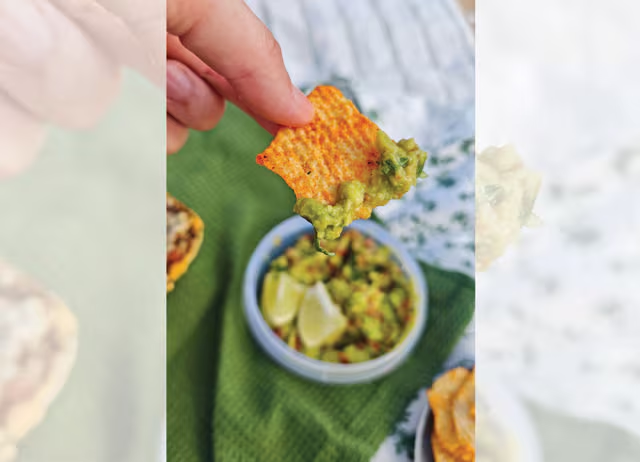
Over the last few decades however, butter has got a bad rap. Doctors now say that we should avoid all fats as much as possible but that butter in moderation is not really harmful. But, at the height of the butter-is-poison hysteria, many people in the West began to long for a non-buttery fat that would fill their mouths and satiate their palates. What they wanted was a healthy version of butter, ideally one that grew on trees and could be treated as a fruit. Which is why it was the right time for the avocado to shine. It had the fatty richness of butter and, yes, it grew on trees. As you probably know, the avocado is a South American fruit. As you also know, fruits and vegetables from South America made their way to Europe in the post-Christopher-Columbus era, and then travelled to the rest of the world. But here’s the thing: Even as South American fruits and vegetables made their way around the globe, nobody had much interest in the avocado. They knew what it was, of course: A sort of unsweet pear. But they did not think it was worth bothering with. Unlike other South American plants, which were prized for their taste, the avocado had very little taste, just a fatty texture. And even then, it had limited use. People would slice it in half, remove the stone and fill the central cavity with vinaigrette. Nobody really used it in other dishes and it remained a sort of expensive salad vegetable. The avocado’s rise to global fame began much later in the 1980s. American farmers had started growing it but found few takers. So the avocado industry began touting the virtues of guacamole, a Mexican dish of chopped avocado with tomato, onion, coriander etc. Even this did not take off until it was advertised as a dip for chips. As the popularity of Mexican food grew in the US, restaurants started serving taco chips and guacamole at the start of the meal. When the US eased import duties on avocados, guacamole became ubiquitous. The success of guacamole demonstrated that once you mixed other flavours with it, the avocado contributed fattiness and texture, which more than made up for its lack of distinctive flavour. Japanese chefs in America had come to a similar conclusion. The avocado’s fattiness and bland flavour allowed the sushi to vaguely imitate the real thing. But the big breakthrough came when a legion of health food crazies adopted the avocado as a superfood. If the avocado is indeed a superfood, then it’s less Superman and more The Incredible Hulk. The avocado has the highest fat/oil content of any fruit. It’s great if you are on a high-calorie diet. Not so great if you are not. It does have various redeeming features in nutrition terms, but the fat content is the biggie. Its advocates point out that much of the fat in an avocado is unsaturated, which is nice. But of course, it’s still fat. We have cultivated avocados in India for years. I used to buy them in Bangalore in the 1990s. Chefs argue that Indian customers now prefer the smoother texture of the imported varieties. And demand has shot up. Seven years ago, I wrote about the beginnings of the Indian avocado craze. Contrary to what you might imagine, the craze was not powered by misguided health nuts who thought Avocado Toast was the ultimate healthy breakfast. In fact the backbone of the demand was the newfound Gujarati love for avocados. As a fellow Gujarati, I know that all the health stuff holds little appeal to my poori and bhajiya-loving people. We just like fatty food. And Gujaratis order Avocado Bhel. Avocado Veg Sushi. Avocado Cheesecake. Avocado Tacos. Avocado Tiramisu. And many avocado dishes that are so outlandish in nature that I shudder to even mention them. Can Gujaratis create an avocado revolution by themselves? Of course. I would argue that we already have. And now the most powerful Gujarati has joined the effort. Last week, Prime Minister Narendra Modi posted an Instagram video urging us all to eat avocados. As you might expect, the Prime Minister’s concern was less with gourmet preoccupations and more with the interests of our farmers. He gave the example of a farmer who had massively boosted his income by planting avocados and asked us to support farmers by eating more avocados. So it’s good to direct consumers to our own avocado harvest.
There are many varieties, but most are descended from the Mexican avocado, which has been around for 7,000 years. It only took off in the northern hemisphere when British grocers began importing avocados in 1968. Up to 30% of an avocado is pure fat.
Because fatty tuna (toro) used in sushi was too expensive, they began adding avocado to their sushi rolls. Because it has less saturated fat than butter it is the answer to every guilty butter-lover’s dream: Fat that grows on trees, nevertheless, say its fans,. Because avocados are not cheap, and those who can afford them are usually rich enough to order the superior imported varieties, it’s an important message,.
Doctors told us that it was bad for our hearts and we were made to switch to margarine, vanaspati and Dalda which, as we now know, are even worse for our health than butter. Without South America, we would never have tasted potatoes, tomatoes, chillis, corn, rajma and innumerable other foods that we can’t imagine today’s Indian cuisine without.
From HT Brunch, September 12, 2026 Follow us on www.instagram.com/htbrunch This superfood nonsense will not work, of course. We should just focus on the butteriness.If the government really wants to push the avocado it should do it the way we Gujaratis have. Just remind people that it’s very fatty, it fills your mouth with butteriness, and it works well with everything from chaat to tiramisu to hot toast. All we need now is for a Punjabi chef to popularise Avocado Parathas and Avocado Makhni. And a South Indian chef to put spiced avocado in his masala dosa. Do that and a bigger all-India avocado boom will commence.
