
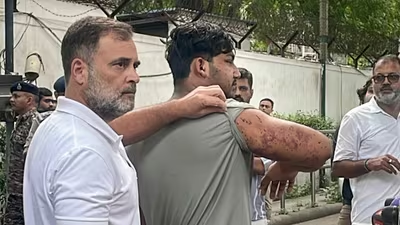
Pellet gun injuries can cause irreversible damage, including blindness, nerve damage and permanent disability, medical experts have said. This comes amid an ongoing political and legal row over their alleged use during the July 20 student protest in Delhi.
Event Context
The Rapid Action Force (RAF) personnel allegedly used pellet ammunition to disperse students marching from Jantar Mantar towards Parliament over the NEET paper leak. The protest ended with police lathi-charging at protesters and using tear gas to disperse the crowd.
ALSO READ | Big scoop on use of pellet guns during CJP Jantar Mantar protest: Police daily diary entry reveals details
The Central government, though, has denied that pellet guns were used. The RAF has said it fired non-lethal munitions, including two rounds of plastic pellets, while Delhi Police has maintained that only tear gas was used.
Doctors said the severity of pellet injuries depends more on where the pellets strike than on how many hit the body.
Player Focus
Shalini Solanki, a forensic science expert at Samrat Vikramaditya Vishwavidyalaya, said pellet cartridges release multiple projectiles. “The severity of injury depends… on the firing distance, pellet size, impact velocity, angle of impact and, most importantly, the anatomical structures involved,” she told PTI.
She said injuries to nerves, blood vessels, bones, joints, the spinal cord and vital organs can lead to chronic pain, permanent disability or loss of function.
Dr Nikhil Valsangkar of Sarvodaya Hospital said pellet wounds are usually superficial when fired from a distance but can cause “massive tissue destruction, soft-tissue loss and extensive bleeding” at close range. He added that damage becomes irreversible when nerves, blood vessels or bones are severely affected.
ALSO READ | Several RAF personnel issued pellet guns on July 20 amid CJP protest at Jantar Mantar, reveals internal inquiry
One injured protester, Sahil Lochab, may lose vision in his right eye, doctors say. His family has claimed doctors told them the pellets recovered from his injuries were made of metal.
Solanki said facial injuries can cause paralysis of facial muscles, while eye injuries may result in partial or complete vision loss.
Dr Sakshi Singhal of Yatharth Hospital said injuries near the shoulder can damage major nerves and blood vessels, causing severe bleeding, loss of limb function or chronic nerve pain. She added that pellet injuries can also lead to blindness, hearing loss, joint stiffness and post-traumatic stress disorder (PTSD).
Clinical psychologist Dr Vandana Prakash said flashbacks and nightmares may persist for years, particularly among younger people, women and those with a history of trauma.
The medical warnings came as the Supreme Court on Thursday observed that pellet guns are permitted under police rules only in “exceptional circumstances” while hearing a plea seeking a ban on their use. The Cockroach Janta Party (CJP), leading the July 20 Sansad march, called it “disgusting.”
ALSO READ | ‘Metallic foreign bodies’ removed in surgery from protester’s body in Delhi, report shows
The court said the legality of pellet guns would have to be challenged through the rules governing their use and directed the Delhi government to provide medical treatment to those injured during the July 20 protest.
Rahul Gandhi has alleged that security personnel fired at students, injuring at least five protesters with pellet-like wounds. In Parliament, he accused home minister Amit Shah of ordering the action.
The BJP has rejected the allegations and demanded an apology from Gandhi, while Union minister of state Jitendra Singh told the Lok Sabha that no bullets were fired and only tear gas was used.
Pellet guns are modified pump-action shotguns that fire cartridges containing hundreds of small metal or rubber pellets, which spread over a wide area after discharge. They are classified as less-lethal weapons intended for riot control but have faced criticism because of the risk of serious eye and facial injuries.
Former CRPF Additional Director General HR Singh said the weapon was developed by the Defence Research and Development Organisation (DRDO) and first used during violent stone-pelting incidents in Jammu and Kashmir in 2009-10, HT reported earlier.
ALSO READ | CJP protests: Pellet guns first used in India in J&K, meant to be used ‘only when other crowd control measures fail’
Their use expanded significantly during the 2016 unrest in Jammu and Kashmir following the killing of Hizbul Mujahideen commander Burhan Wani, when hundreds of civilians suffered eye injuries.
source
Images of injured protesters showing pellet-like wounds later circulated online. Congress leader Rahul Gandhi held a press conference with one such student who was injured with metal pellets.
Security officials say pellet guns are generally part of the RAF’s riot-control inventory and are intended to be used only after lower levels of force fail. According to standard operating procedures cited by officials, they are meant to be fired from a safe distance and aimed below the waist to reduce the risk of severe injury.
