
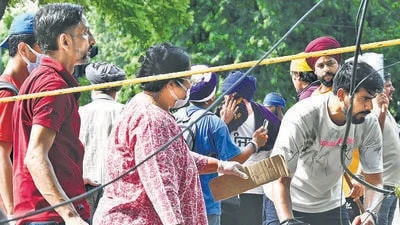
The student protests at Jantar Mantar ended on Saturday night. HT profiles some volunteers who helped keep it running
Event Context
Every day, at 6.30am, before the slogans rent the air and thousands streamed into Jantar Mantar, he would take his place at the entrance of the iconic protest site. A Rajasthan government employee, the 30-year-old was not supposed to be here. He applied for medical leave on 19 July, and left without telling colleagues, aware of the consequences if he was found out. But there was no other option.
“The SSC paper leak in 2023 in Rajasthan changed my life. I could not clear the exam. I filed a case. I could not return till this issue was resolved,” he said. Every night at 11pm as a new round of volunteers took over, he walked to Gurdwara Bangla Sahib to bathe, rest for a few hours, and recharge his phone. Before sunrise, he was back, checking movement and guiding people into the site.
By 8am, scores of volunteers like him – all wearing blue rubber gloves – would emerge, carrying garbage bags. Some swept rain-soaked pavements littered with disposable plates and water bottles from the previous night. Others unloaded cartons of donated food. Tea was poured into paper cups. Breakfast packets changed hands. A small medical camp started arranging medicines, while volunteers adjusted loudspeakers and cables on the makeshift stage.
Also read: Rahul guns for Amit Shah over ‘pellets fired’ at CJP march as Parliament session resumes, , govt plans a bill move
Nobody assigned them these jobs. There were no registers, attendance sheets or supervisors. Young men and women arrived, looked around and began doing whatever they thought needed to be done. Some stood at the entrance, others formed human chains near the stage. Hundreds waved hand fans over people standing in long queues while others helped coordinate an impromptu poster-making workshop in a corner.
By noon, donations would start mounting. The supplies went far beyond food. Volunteers unloaded cartons containing toothbrushes, toothpaste, slippers, plastic sheets, bedsheets, first-aid supplies, brooms, wipers and battery-operated fans.
Also read: Who’s on PM Modi’s task force for exam reforms? Here’s what we know
“There is a lot to do here. You can just pick something and start doing it,” said Mohammad Kaif, 18, who travelled from Moradabad to Delhi two weeks ago, sleeping, eating and studying at Jantar Mantar. A civil services aspirant, Kaif did everything from distributing food and cleaning to managing security and fanning exhausted protesters. “I want the future of children not to be destroyed by another paper leak, including mine,” he said.
From Sonepat, Kanpur & Varanasi
For four days, professional boxer Joginder Sharma, 27, boarded the 5am train every morning from Sonepat for Delhi, spent the day volunteering at Jantar Mantar, and returned by the 11pm train at night.
“I cannot stand for very long because I recently had surgery on my leg, but I wanted to come. The students who died because of the NEET paper leak deserve justice,” he said.
Also read: Nandan Nilekani to lead exam reforms: Amid Gen-Z ire, Modi taps all-season technocrat
Artist Pravindra Singh, 22, came from Kanpur two days before the July 20 march, believing he would return immediately afterwards. The violence convinced him to stay put. “My parents stopped talking to me. I only spoke to my younger sister,” said Singh.
He alternated between sleeping at the site and at friends’ houses. After supplies ran out, his life ran on donations at the site. “I came prepared for only two days. People were kind,” he said, with a smile.
Siddhant, a 23-year-old law student from Varanasi preparing for judicial examinations, came to Jantar Mantar on 21 July, and immediately started picking up banana peels, wrappers and discarded food containers from the site. He arrived around 8.30am every morning and returned to a friend’s house in Malviya Nagar close to 1am.
“I am not associated with CJP or any committee… I bring my own food in a tiffin,” he said, tapping his backpack.
Only after the swelling crowds finally began to thin late in the night did the volunteers themselves head home—some after days of living at the protest site, others after spending entire shifts without joining the celebrations. Many boarded the Metro trains, with stations finally opened, while others packed their belongings and prepared for journeys back to cities across the country via New Delhi Railway station on Sunday.
The Rajasthan government employee is now back home, readying to rejoin work on Monday after a week in Jantar Mantar. “I may lose my job if they find out I was there,” he said. “But some things are bigger than your fears.”
Player Focus
With thousands eating donated meals every day, managing waste became among the protests’ most challenging goals. Volunteers gathered litter into collection points before NDMC sanitation workers arrived during limited access windows. Last Thursday, for example, around 15 tonnes of waste were removed.
Siddhant said missing the July 20 march because of an examination was an abiding regret. “I was terrified by the visuals of a policeman shoving a stick in a girl. It was sexual harassment. A 16-year-old school kid was crying helplessly. You don’t hit people who are not doing anything,” he added.
Near one of the entry queues was stationed a 19-year-old undergraduate journalism student from Uttarakhand, busy fanning people waiting to enter. She and two classmates, all journalism students from different states, arrived every morning at 8am and left by 3pm.
“We told our families we were attending an NCC camp. Otherwise they wouldn’t even let us leave our PG. Visuals of girls like us being beaten, clothes being torn changed everything for us,” she said.
Access to basic facilities was difficult. “We went to Gurdwara Bangla Sahib. That is the only space that has sheltered us,” she said. “I blocked my parents on social media so they didn’t get to know about us being here,” she said.
A critical time for volunteers was when tensions flared at the site – most notably last Wednesday, when sporadic violence left five police personnel and five protesters injured. Volunteers climbed atop police buses or barricades, issuing appeals for calm over loudspeakers, picked and removed stones from the road, and formed human chains to separate the police from protestors.
Also read: Delhi’s Gen Z turns Jantar Mantar protest site into weekend hang-out spot after Pradhan’s resignation
“The people who are protesting and the volunteers involved worked very hard to keep this entire protest peaceful and it is only with their cooperation that people remained under control,” said Delhi Police special commissioner Ajay Chaudhary.
Evenings was when the site came alive. The crowds swelled. Floodlights illuminated Sansad Marg. Volunteers served food, directing people through barricades and clearing litter from the roads. Sometime after midnight, one batch of volunteers – the Rajasthan government employee among them – would quietly slip out. Another group of young people – who last week transformed into cleaners, medics, security guards, cooks, artists and organisers without ever being asked – would take their place.
On Saturday, after Dharmendra Pradhan’s resignation as Union education minister, a key demand, the protest was called off. Despite this, long after the stage had fallen silent and the protest leadership had dispersed, they stayed back to sweep roads littered with plastic bottles and banners, guide thousands of people towards exits, dismantle makeshift aid kiosks, and ensure that those returning to railway stations, bus terminals and gurdwaras did so safely.
Match Outlook
Also read: Hunger strike, police action, and Gen Z: Key moments from CJP’s 36-day Jantar Mantar protest
