
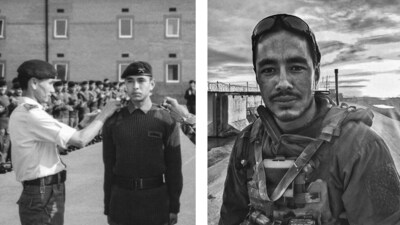
Nepali by birth, British by nationality, a soldier by training, and a mountaineer of global fame. But, among all his identities, mountaineer Nirmal Purja was most proud of his ancestral heritage that was a common thread in all of it — that he was a Gurkha.
Event Context
He died in an avalanche in Pakistan as he was on his latest expedition, a climb to Broad Peak in the Karakoram range of the Himalayas.
“Being a Gurkha was my only dream… It was the only thing I wanted to do,” he wrote in his book. Gurkha is a name used for certain hill communities in Nepal and India, historically designated as a “martial race”, famed for fierce loyalty and unmatched bravery.
Nirmal Purja, 43, was ‘Nims Dai’ (his nickname followed by Nepali for ‘older brother’) to the international community of climbers and adventurers. A former soldier in the British army that continues to specially recruit Gurkhas — as do the Indian and Nepali armies — Nirmal Purja had climbed the world’s 14 highest peaks within a record 189 days in 2019. That achievement was featured in a Netflix documentary, ‘14 Peaks: Nothing is Impossible’. The record was later surpassed, but his fame was not about numbers alone.
Born on July 25, 1983, in Dana village in Myagdi district of Nepal, he grew up largely in the flatland town of Chitwan, in a family with a long history of military service. His father and three older brothers all served in Nepal’s Gurkha regiments, The Kathmandu Post noted.
“Instead he had another focus: to become a Gurkha, a member of the elite British Army regiment, like his father and brothers before him. He made that dream a reality when he joined the Gurkhas in 2003, at the age of eighteen,” it adds.
In all, Nirmal Purja served 16 years in military service.
He was appointed a Member of the Order of the British Empire (MBE) in 2018 for his military service and mountaineering achievements.
He had started his climbing career with a 2012 trek planned for the Everest Base Camp; but he did not stop at that as he converted that simple hike into a summit push. It was a lesson. He later summitted Mount Everest for the first time in 2016, followed by ascents in 2017, 2019, 2021, 2022, and 2026 too.
In 2019, he started his big push for what became the documentary ‘14 Peaks’.
“I gave up my job in the United Kingdom. I gave up my pension and sold my house for this high-altitude, high-speed quest,” he told reporters at the time, TKP wrote on Saturday.
That was part of his 14-peak expedition that included Annapurna and Dhaulagiri, then Kanchenjunga, and Everest in Nepal; the adjoining Lhotse peak, then Makalu. In Pakistan, he climbed Nanga Parbat, Gasherbrum I, Gasherbrum II, Broad Peak and K2, before returning to Nepal for Manaslu, Cho Oyu and, finally, Shishapangma.
He later co-founded Elite Exped with fellow mountaineers Mingma David Sherpa and Tejan (TJ) Gurung.
Its mission statement read: “We aim to help people achieve their new possibilities through adventure… take you above and beyond breathtaking, high-altitude adventures.”
Match Outlook
Nirmal followed that path expectedly. He served in the British military for six years, and was the first Nepali to be accepted into the British Special Boat Service, an elite unit of the Royal Navy.
“Astonishingly, given his seemingly god-given abilities in the high mountains, Nims didn’t grow up in the shadow of the Himalayas. In fact he was born in the Dhaulagiri region of Nepal and raised in Chitwan, in the country’s flatlands. He performed well at school, but had no particular yearning to climb mountains,” says his profile on his company’s website.
“Nobody believed it could be done. Everyone was laughing at me when I launched Project Possible,” he said. That record-breaking expedition took him across Nepal, Pakistan and Tibet. He had earlier too climbed Broad Peak, where he died.
