
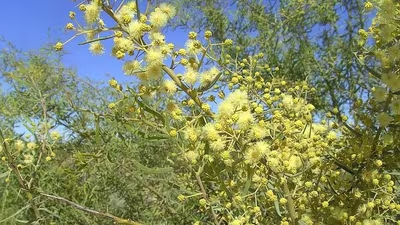
The Northern Territory Government says prickly acacia was first introduced to Australia as a shade and fodder tree. It now infests more than 6.6 million hectares of the country and is listed by the government as a Weed of National Significance, a national label applied to weeds with major impacts. A tree brought in to help Australian farms has become one of the country’s toughest weed problems.
The tree is native to tropical and subtropical Africa, Pakistan, India and Myanmar. It was later sold as a source of shade and feed for sheep, although it had long been known as a problem in cattle country. Cattle are a large factor in its spread. Livestock can carry seeds away from the parent tree. It can take six days for seeds to pass through an animal. The seeds can also be carried by water. Once established, the tree flourishes along watercourses and outcompetes native plants. The Kriticos paper also notes that the weed increases mustering times and costs, and increases soil erosion. Native plants and animals also suffer as the thickets force them out and reduce biodiversity . The thorns are also a problem, as they can puncture vehicle tires and cause injury to animals. Researchers used a climate model to predict where the tree might be able to live. They found that the potential range of the species under present conditions is far greater than its present distribution. In their model, suitable or highly suitable habitat covered over one third of Australia . They mentioned that the model ignores other factors affecting the tree’s distribution, like soil type and land use.
It came to Australia in the 1890s for shade, fodder and ornamental purposes, according to a 2003 study by Kriticos and colleagues in the Journal of Applied Ecology . By 1926, it was established in the Bowen and Rockhampton districts of Queensland. It was not declared noxious until March 9, 1957, by which time it had spread across much of central and western Queensland, the paper said. It can reach up to 10 m in height and forms dense thickets.
The government says the seeds are carried on the hair and hooves of cattle and also pass through a cow’s digestive tract intact. The Kriticos study says the plant moves across a paddock boundary mainly through livestock eating and defecating the seeds. Dense infestations reduce pasture production, and thickets make mustering harder and limit stock access to water, according to the government. The government says the weed threatens farming and the environment across much of northern Australia, including the Barkly Tablelands in the Northern Territory. The authors also said climate change is likely to expand the area.
The paper suggests that simple paddock quarantine, which gives livestock time to drop seeds before moving, may help limit the plant’s range. The government also recommends similar measures, such as fencing stock away from mature pods and quarantining animals moved from infested areas. The best season to treat the plant is identified as March to May. Researchers in Queensland have also explored biocontrol options such as insects. Taken together, the story shows how a tree planted for shade and feed became a lasting problem.
Research has found that early action coupled with a yearly control program offers the best return on investment, it says.
