
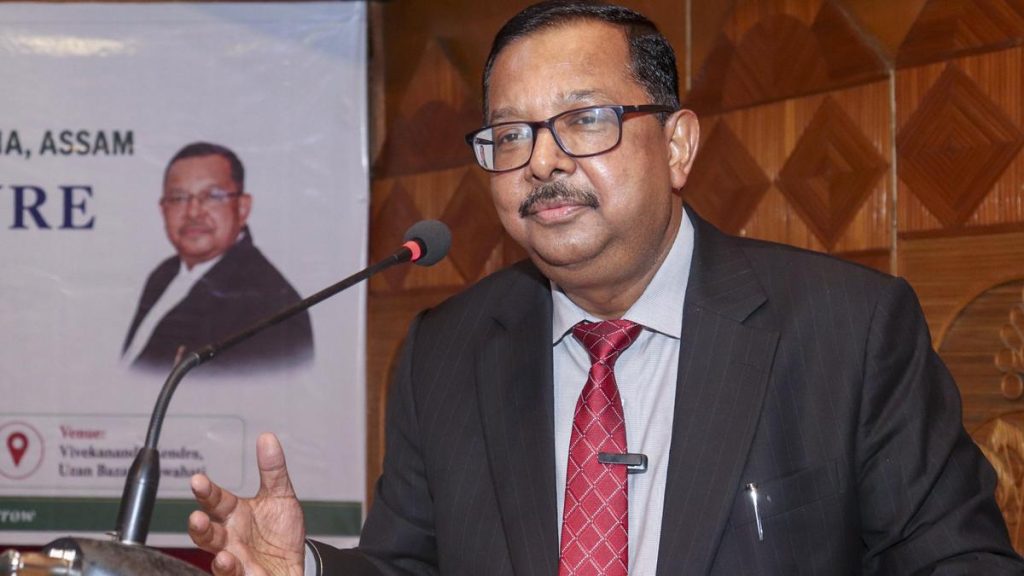
As student bodies across premier national universities object to Chief Justice of India’s remarks and refuse to have him over for their convocations, Supreme Court judge Justice Ujjal Bhuyan on Sunday (August 30, 2026) pushed for the activation of Presidential power to appoint ‘distinguished jurists’ as judges in the top court of the country.
The BCI had to retract the move after public pressure . The comments from the Supreme Court follows a recent debacle by the Bar Council of India, which ordered State Bar Councils to bar the professional enrolment of the 2026 batch of NALSAR students for objecting to have the CJI over as chief guest for their convocation for his oral comments in court about ‘cockroach’ and ‘parasites’.
“While our Constitution has a provision for appointment of a jurist as a judge of the Supreme Court, no jurist has been appointed so far to the Supreme Court though the Constitution has completed more than 76 years,” Justice Bhuyan pointed out at the 13th convocation of the 2026 LLM batch of the National Law University, Delhi. The Judge said the maturity of a democracy was reflected not merely in how it responds to opinions that were difficult, unpopular or inconvenient. The courage to voice unpopular opinions begin at universities, Justice Bhuyan said.
“But this is a very shallow objection. Supreme Court is not only the highest adjudicatory body but it is the moral, legal and constitutional conscience keeper of the nation. It is above technicalities.
The reason for having this provision of distinguished jurist in Article 124(3) is to diversify the Bench with talented judges,” Justice Bhuyan said. As a result, brilliant minds, men and women with legal scholarship, who could have significantly contributed on the Bench missed the opportunity to serve as judges of the Supreme Court.
Justice Bhuyan said the 76-year reluctance to activate Article 124(3) for appointment of legal academics as Supreme Court Judges in the category of ‘distinguished jurists’ may have been either due to the feeling that there was not enough “depth in the Indian academia” or because the provision was simply not seriously taken. In India, the Judge said, the term ‘jurist’ was very loosely applied.
