
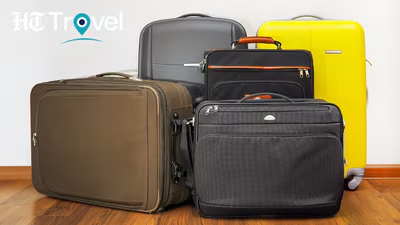
After travelling with more suitcases than I care to count, I have become slightly obsessed with how people pack. I notice the huge suitcase being dragged through the airport for a three-night trip, the tiny cabin bag that somehow weighs more than the person carrying it and the traveller trying to close an expandable case while sitting on it. I have done versions of all three myself. The funny thing about luggage is that we tend to shop for it by looking at the specifications first. How many litres does it hold? How many wheels does it have? Is it hard shell or soft shell? How many compartments are inside? Those details matter, but they do not always tell you how the bag will behave once you actually start travelling with it.
I have become much more conscious of this after travelling frequently. When I am packing for a short trip, I would rather have a case that makes me stop adding unnecessary things than one that gives me enough room to pack for every possible version of the holiday. The same applies to cabin luggage. A bag may have plenty of physical capacity, but if your airline allows only 7kg, that is still the number that matters at the airport. The material is only one part of a suitcase’s weight. Wheels, handles, locks, frames and internal fittings can add quite a bit too, which is why two bags of a similar size can feel completely different on a luggage scale. I have used both hard and soft luggage extensively, and I would not choose between them simply by looking at the outer material. A hard shell can be useful when I am carrying something that needs protection, particularly electronics or other fragile items. A soft case can make more sense when most of what I am carrying is clothing, and I want some flexibility while packing. The empty weight is worth checking, but it should not be the only number you look at.
Destination Buzz: Planning a Switzerland train holiday in 2026? The catch becomes obvious when you actually carry a fully packed duffle through an airport. I have travelled with bags that felt perfectly manageable when I picked them up at home and considerably less charming after a long walk between gates. A trolley gives you wheels for a reason. So if I am taking a short trip with mostly soft clothing, a lightweight duffle can be a very sensible option. If I know I will be spending hours walking around an airport or changing between different forms of transport, I am much happier rolling my luggage. Stairs, uneven pavements, station platforms and crowded public transport can all make a different wheel configuration more practical. Four wheels also add weight and occupy some space within the case, so the choice is not quite as simple as saying that more wheels equal better luggage. For someone who spends most of their travel time inside airports and hotels, spinner wheels can be brilliant. For someone who regularly lifts their luggage, uses public transport or walks on uneven surfaces, other designs can work just as well. I love expandable luggage for one very specific reason. It is brilliant when you come home with more than you left with. That extra space can be incredibly useful after shopping, especially when you have managed to squeeze everything into a smaller configuration on the way out. The mistake is assuming that the additional capacity somehow changes your baggage allowance. It does not. But there comes a point where saving a few hundred grams is not worth compromising on everything else. I have had travel days where a good handle mattered more than the empty weight of the suitcase. I have walked long distances through airports where smooth wheels made a bigger difference than an extra bit of packing space. And when I am carrying electronics, I care far more about protection than saving the last few grams. After using so many different types of luggage, I have stopped looking for one perfect bag. The luggage that works for a quick work trip may not be what I want for a family holiday, and the bag that is brilliant for airport transfers may not be the one I want to carry on public transport. Here’s what to know about the Grand Train Tour
