
LIKE a villager urging neighbours to confront a prowling predator together, Mark Carney sought to rally the world’s middle powers. In a speech in January to the World Economic Forum at Davos, Canada’s prime minister issued an urgent call for mid-ranked countries to unite. The old rules-based order no longer constrains the mighty, he advised. Nor can smaller countries roll over and hope that submission keeps them safe.
This is an age in which the strong prey on the weak, he told his audience of grandees. Middling powers can act together in coalitions of the willing, or “be on the menu”.
A surprising number of political leaders express sympathy for Canada as a victim of Mr Trump’s bullying, but behind closed doors grumble about the naivety of Mr Carney’s advice that middle powers just need to be braver. Not every country is as lucky as Canada, they note. Canadians are blessed with abundant oil, gas and hydroelectricity. Secure in the high north of the Americas, deterring Russia is not the urgent task faced by some fellow members of NATO. Canada can confront America in a way that Europeans cannot, sniffs a senior European. In Japan and other Asian countries, there is impatience with Mr Carney’s talk of middle powers leading the world.
Only America can deter China, it is said in Tokyo, and Canada is not about to save us.
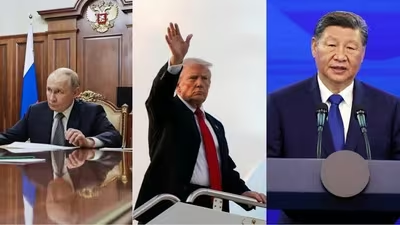
Mr Carney was speaking from experience. After decades as a comfortable, if unexciting, annexe to the American economy, Canada finds itself the object of President Donald Trump’s wrath. Mr Carney has worked hard to reduce his homeland’s dependencies . Other middle powers have studied his confrontation with Mr Trump closely. Yet nine months on, the response to that Davos call to arms looks distinctly patchy. Asia has witnessed shows of defiance, too. Despite intense pressure from China, including curbs on Chinese sales of critical minerals, Japan’s prime minister refuses to apologise for saying an inconvenient truth aloud. Takaichi Sanae’s offence was to confirm publicly that Japan’s national security would be imperilled by a Chinese attack on Taiwan, Japan’s democratic neighbour. As Chinese officials hurl insults and call her a war criminal, Ms Takaichi cannot back down, politically, and will not. Brazil and India belong on the list, though some in those countries aspire to emerging great-power status. Russia thinks of itself as a nuclear-armed superpower, though its economic and demographic woes, and dependency on China, make it a pretty mangy big beast. For all that, Russia is more than a mid-ranking player: its president, Vladimir Putin, is one of a few foreign leaders treated as a peer by Mr Trump, and Russian aggression haunts the wakeful nights of politicians across Europe. There are small countries that control vital technologies, such as the Netherlands or Taiwan, both home to firms that are irreplaceable to semiconductor supply chains. Then come hyper-ambitious powers with commercial or military interests far from home, such as Israel, Saudi Arabia or the United Arab Emirates. In theory, America and Russia are still adversaries. But in Washington horrified European allies find themselves being scolded by some officials in the Trump administration for backing Ukraine. Such support is called a provocation of Russia. It is not clear how long the current truce between America and China can last. Mr Trump has never been an ideological China hawk, if that means someone who disapproves of the Communist Party’s iron-fisted rule. Now, in his second term, he has no interest in changing China’s ways, whether that means confronting China over its economic model or its regional ambitions. He is more interested in selling China soyabeans, flogging Boeing planes and securing supplies of Chinese rare-earth elements. Judging by their recent summit, neither Mr Trump nor Mr Xi is minded to heed calls from the rest of the world to permit more oversight of their respective champions of artificial intelligence. In September Mr Trump wooed Mr Xi during that visit to Washington, meeting him in person at Joint Base Andrews, among other shows of respect. Mr Trump expected China to repay him with actions to help Republicans in the midterms, for instance by boosting Chinese diesel sales. Instead, China enraged the president by curbing diesel exports just days later. This instability points to an unenviable choice facing smaller powers. Do they prefer accommodation of China by Mr Trump, based on a division of the world into spheres of interest, or a resumption of full-blown rivalry between two giants?
Because of one man, who sits in the Oval Office, it exists largely.
To that end, he has told his diplomats and generals to avoid starting a war with President Xi Jinping and is holding up promised arms sales to Taiwan. That said, the truce with China could end at any moment, for Chinese leaders are playing hardball in large ways and small. His fellow leaders knew that Mr Carney was mostly warning them about America and China, the strongest of today’s big beasts.
