
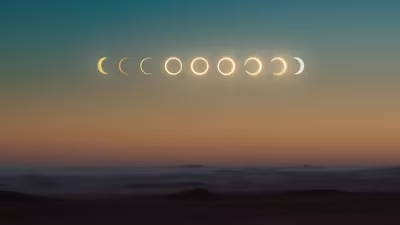
A partial lunar eclipse will take place on August 27-28, giving people across much of the US a chance to watch the Moon pass through Earth’s shadow. The sky has another eclipse in store for stargazers this month.
When is the next lunar eclipse?
NASA lists the August event as the second lunar eclipse of 2026, following the total lunar eclipse on March 3. Also Read August Blood Moon Lunar Eclipse 2026: Dates, timings and astrological significance The eclipse will be a partial lunar eclipse. At its peak, about 93% of the Moon’s diameter will be inside Earth’s darkest shadow, known as the umbra, according to NASA. NASA’s eclipse data places the event on August 28 in Universal Time, while local dates and times vary across the US.
The August eclipse will be visible across much of North and South America, as well as parts of Europe and Africa. The Moon will not disappear completely, but the shadowed portion can take on a darker, rusty or coppery appearance. You do not need special glasses to watch a lunar eclipse. Find a location with a clear view of the Moon and, if possible, move away from bright lights. You can watch the eclipse without equipment, while binoculars or a small telescope can make Earth’s shadow easier to see moving across the lunar surface.
NASA says it is safe to view a lunar eclipse with your eyes, unlike a solar eclipse.
