
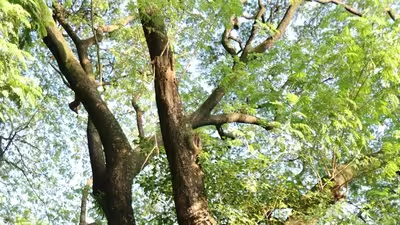
Today, that same tree is associated with damaged homes and costly power repairs. Hawaii once planted a tree to protect its hillsides. But the plan backfired over time, and the tree became a major problem for people and for forests.
Because they wanted trees that grew quickly on eroding slopes, the Big Island Invasive Species Committee , a group based on Hawaii Island, says foresters brought albizia to Hawaii.
The damage is not limited to storms. Flint Hughes and Julie S. Denslow explored how albizia changes native forests. The researchers worked in some of the last remaining patches of native wet lowland forest, on Kilauea lava flows on the Big Island of Hawaii . They compared native-dominated areas with those invaded by albizia. Invasion altered the function and structure of these forests, they found. Nonnative species, particularly strawberry guava, increased, while native species, particularly ohia, decreased. The authors suggest that the future of these forests depends mostly on the extent to which albizia spreads. The committee also notes that albizia’s shade can prevent many native species from growing. The committee also provides a list of certified arborists who remove albizia and instructions for reporting hazardous trees on neighboring property. Large trees or trees near structures, roads, or power lines should be evaluated and removed by a certified arborist. Planting a fast-growing tree is easy, but living with the results for more than a hundred years is much harder.
A study published in Ecological Applications in 2005 by R.
