
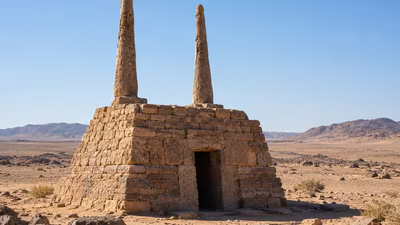
Now, a new excavation has established that the monument was used for burial roughly 4,400 years ago. A strange stone monument stretching across the desert has given archaeologists a rare glimpse into how prehistoric communities in the Western Sahara buried their dead. Built from limestone slabs and marked by two long, antenna-like extensions, the structure had remained difficult to date and even harder to interpret.
However, the researchers have not established that the Lawash el Telli structure served any astronomical purpose, making its funerary role the clearest interpretation supported by the excavation . The monument also stands in a landscape rich in prehistoric activity. Beneath layers of loosely arranged stones, the team discovered a second structure made from larger limestone slabs. Under this protective covering lay the remains of a single individual. The burial showed no evidence of later disturbance or reuse, allowing researchers to study the monument in a relatively undisturbed context. The deceased had been laid out supine, with the head oriented south and the feet pointing west. There were few objects found buried with the person; only four beads, made of ostrich eggshell, in a ring-like shape. Beads such as these have been found at several prehistoric sites in the Atlantic Sahara; thus, they do not reveal much about the culture to which this person belonged. Two grains of pine pollen were also found in the sediment sample.
Nearly 1,140 engraved rocks have been documented along about 27 kilometres of the nearby wadi, containing more than 2,000 individual figures. Archaeologists excavated the monument between April 5 and 8, 2018. As the skeleton had not been preserved well, the sex could not be established, but based on the dental wear, the individual would have been between 25 and 35 years old.
Because of the site’s remoteness and difficult conditions, they investigated only part of the mound, leaving the remainder intact for future work. The carvings include animals such as cattle and ostriches, offering evidence of a very different Sahara from the extremely dry environment seen today.
The biggest breakthrough came from scientific dating. The two samples produced closely matching dates. The researchers noted that the monument dates to the later part of the region’s Late Neolithic period, when communities were already building several forms of stone funerary structures. The evidence suggests that antennae tumuli overlapped in time with crescent-shaped burial monuments, indicating that different monumental traditions existed alongside one another.
Researchers returned to the remains in 2025 and instead analyzed the mineral component of the bone. One fragment of the humerus dated to 4,417–4,160 calibrated years before present, while a femur fragment produced a range of 4,405–4,100 years. When combined, the results place the burial mainly between about 4,407 and 4,230 years ago.
Because the bones no longer contained enough collagen for conventional radiocarbon analysis, initial attempts in 2018 failed.
