
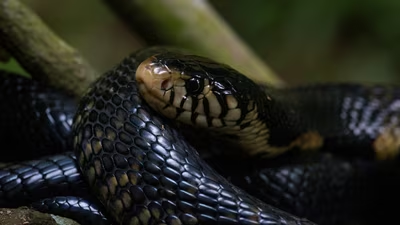
In 2024, University of Florida researchers reported a new DNA test for four invasive snakes. Florida has a snake problem, and it’s hard to see. The University of Florida news release calls it a pioneering tool for showing where invasive species have been.
Is built to detect the DNA of Burmese pythons, northern African pythons, boa constrictors, and rainbow boas from environmental samples, and in early controlled tests it picked up Burmese python DNA in both water and soil, according to a study in Ecology and Evolution .
From there, the news release notes, efforts shift to containment or long-term management, both of which can be costly for native wildlife and for funding. The test is called a tetraplex digital PCR assay. Brian Bahder, a senior author and associate professor of vector entomology at the same center, calls it essentially four tests in one. Each part detects one species without detecting the others. The study agrees, reporting no cross-amplification across species, and calls this the first tetraplex digital PCR assay for four invasive constrictor snakes. The release adds that Bahder usually works on detecting lethal bronzing in palm trees. The technique uses eDNA, or genetic material organisms shed into the environment.
The study says Florida has more than 500 nonnative species, more than 50 established reptiles, and that $10.6 million was spent on Burmese python removal from 2004 to 2021. It also notes that visual surveys are estimated to detect less than 5 percent of Burmese pythons. Because the main difference is the DNA sequence, he explains that the molecular testing works similarly across organisms.
Melissa Miller, the lead author and an invasion ecologist at the UF/IFAS Fort Lauderdale Research and Education Center, says once a nonnative species is established, it is often too late to get rid of it. Co-author Sergio Balaguera-Reina says secretive species like most snakes are hard to detect, even at high densities.
What’s next for the test
The researchers are cautious about the implications of the findings. The study adds that field performance still needs to be evaluated and will be the subject of future research. Miller notes testing for many species in one sample could reduce survey costs, and she hopes the tool will help with early detection and rapid removal.
Bahder said in the release that concentration estimates are only the first step and that more experiments are needed to understand how time, distance, and environmental factors affect detection. Co-author Frank Mazzotti said in the release that the team’s first next step is adding more species to the assay, especially fish like Asian swamp eels and bullseye snakeheads, which would extend it beyond snakes. He also said the team plans to set up a regional sampling network to detect new invasions early and assess removal efforts across the area covered by the Comprehensive Everglades Restoration Plan.
