
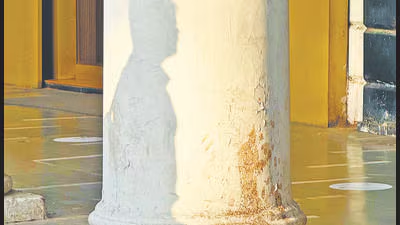
A man is walking in Connaught Place. He is in the Inner Circle. White columns line his path. The columns were built during British rule, along with CP’s original buildings. The man’s shadow falls on one column, his head and shoulders appearing clearly on the plaster—see photo. He walks on. The shadow leaves that column and appears on the next. The sight is surreal. October light and CP’s architecture are making this jugalbandi possible.
This evening, in the clear sunlight of early winter, the columns have exchanged their reflections for shadows. Just stand at one end of the F block colonnade and look along its curve. The columns cast long shadows across the paving. Shoppers and hawkers are walking over those shadows. But look at the columns themselves. The shadows of these same passers-by are falling on the plaster. Without realising it, we citizens are leaving something of ourselves on our city’s historic surface. So what if it is lasting only the fraction of a moment.
A manual count conducted for these pages last year recorded 316 columns in the Inner Circle, 740 in the Outer Circle and 530 in the connecting corridors. Altogether, 1,586. CP’s showrooms and restaurants in Central Delhi have come and gone over the decades. But these columns have continued to stand. Now, with winter approaching, the afternoon sunlight is poetically hijacking the surfaces of these columns. But on the month’s clearer days, before winter’s heavier pollution sets in, the light has a glassy quality. Indeed, dear reader, this is your cue to visit CP and look beyond its shop windows. The columns support the ceilings of CP’s Inner and Outer Circle colonnades. They also line the corridors connecting the two. Even a few of these columns catching the afternoon sunlight might keep the stroller occupied. Outside a stall in the Inner Circle, for instance, the shadow of a leafy branch of a pilkhan tree curves around a column. The tree itself is out of view, but marking its presence on the white plaster. Further along, small ovals of sunlight lie scattered across another column. The light effects extend beyond the columns. On a colonnade’s white wall, patches of sunlight surround the shadows of passers-by. Steps ahead, above the shops, a window stands open beneath the faded Kailas Carpet Co. sign. The hall inside looks bare and deserted. The window’s semicircular framework is casting its shadow onto a wall of peeling plaster within. The columns have their moments sans the sun too. A month ago, rain was falling heavily in CP. Covered by a thin film of water, the paving along the colonnades had become a mirror. Each column had thus acquired a twin, one upright, the other upside down beneath it.
Truth be told, this play of light is not confined to October.
