
The Centre on Wednesday raised the minimum support prices (MSPs) for all six Rabi crops for the 2027–28 marketing season, giving the biggest price boosts to oilseeds and pulses.
The MSP of safflower received the largest absolute hike of ₹ 675 per quintal (up 10.3% to ₹ 7,215), followed by rapeseed and mustard with a ₹ 413 per quintal increase (up 6.6% to ₹ 6,613), according to a statement after a meeting of the Cabinet Committee on Economic Affairs (CCEA), chaired by Prime Minister Narendra Modi.
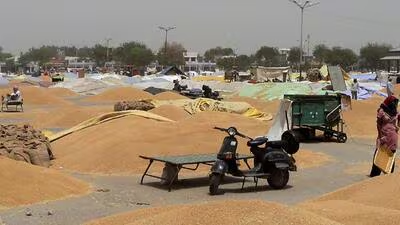
The latest MSP come as the government prepares for a Rabi season under climate uncertainties. The relatively small increase in wheat comes against a backdrop of elevated government stocks. The MSPs are in line with its Budget 2018-19 commitment to fix MSP at least 1.5 times the all-India weighted average cost of production, the official statement said. A total amount of ₹ 90,962 crore was approved by the cabinet for this procurement. FCI wheat stocks at the beginning of September were up more than 44% from a year earlier, according to FCI data cited by commodity market publication Informist. The government procured 35.76 million tonnes of wheat in the 2026-27 Rabi marketing season, up more than 19% from the previous year.
The government said the higher MSPs are aimed at ensuring remunerative returns to farmers and encouraging crop diversification, particularly towards pulses and oilseeds. “Water availability and soil moisture should be assessed before finalising crop plans,” Chouhan had said, stressing the need to promote less water-intensive crops such as pulses and oilseeds. The high stock position limits the scope for a sharp increase in the wheat MSP, as the government is already carrying substantial inventories, according to market experts.
On Tuesday, agriculture minister Shivraj Singh Chouhan asked states to align crop plans with water availability and soil moisture and prioritise pulses and oilseeds in water-stressed areas.
