
A mother who has lost three children. Another who says she has lost six. Chandigarh: A passport-size photo of a dead son. A former soldier who fought wars on the border but could not save his own son from narcotics.
Covering nearly 4,000-km across all 117 assembly constituencies through four simultaneous yatras, the campaign began on September 18 and will culminate in Jalandhar on September 30, where Union home minister Amit Shah is scheduled to address a rally. With the drug crisis remaining a deeply emotive issue across the state, the timing of the yatras—coming less than six months before the 2027 polls—places the issue firmly at the centre of Punjab’s political conversation. The party’s four-pronged Nasha Mukt Punjab Yatra is ostensibly a campaign against substance abuse, but the political messaging is unambiguous: The BJP is seeking to make the drug crisis a referendum on the performance of the Aam Aadmi Party (AAP) government while positioning itself as the sole force capable of tackling the problem.
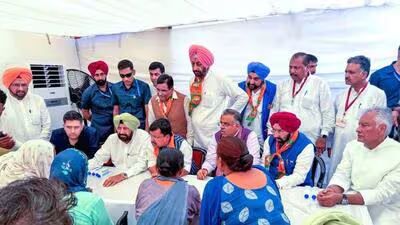
The outreach follows a strictly calibrated protocol: Whenever a central leader joins the yatra, affected families are brought into a special enclosure behind the main stage. Their testimonies are recorded by the BJP’s central office team and subsequently integrated into campaign speeches and video clips to highlight local severity. Party leaders have interacted with about 1,100 families who have lost members to drugs, aiming to reach 2,000 families before the campaign ends, according to internal BJP records.
In Bathinda, a 61-year-old woman recounted to Union agriculture minister Shivraj Singh Chouhan how she lost her three sons—aged 18, 21, and 27—to chitta (heroin). Within 13 years, they were all gone. In Ludhiana’s Jagraon, Shindo Bai, who lost six sons to drugs, broke down during the BJP’s Mawan Mangdian Jawab (Mothers Demand Answers) outreach programme.
Rather than relying purely on statistics regarding seizures, arrests, and supply lines, the party is focusing mothers, widows, and siblings on stage—allowing survivors to articulate the impact of addiction through personal loss. “It started with my eldest son. No one was saved. Chitta consumed everything.
“ Chitta is available in the streets like sugar,” Shindo Bai said. Poor households have been hit the hardest,” she said.
