
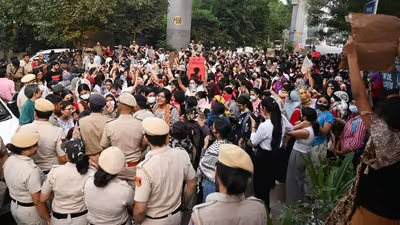
The Supreme Court on Monday took suo motu cognisance of rising instances of sexual assault against minors and women in the national capital region seeking response from Delhi police and stating that public spaces including parks, buses and roads cannot be made “zones of high risk”.
The court held police to account as it noticed in the news report that in the Astha Kunj incident, it came to light how students of LSR College had complained of instances of sexual harassment that went unaddressed. A bench of justices JB Pardiwala and K Vinod Chandran took note of the news reports concerning the recent rape of a 17-year old at Astha Kunj park near Lady Sri Ram College, the gang-rape of a minor at Swaroop Nagar, and the sexual assault of another minor inside a bus travelling from Greater Noida to Delhi.
“Regrettably, these complaints failed to rectify the security lapses through advanced surveillance.”
Taking serious exception to the repeated incidents of sexual assault on minors, the bench said, “One cannot help but draw a painful parallel to the 2012 Nirbhaya case and wonder whether lessons have been learnt. The right to live with dignity free from violence is a fundamental guarantee under Article 21 of the Constitution. There are occurrences of sexual assault across NCR despite the guarantee of public safety.
Noticing that the above incidents occurred inside a park, road and a bus, the bench said, “Public spaces, include parks, roads, buses, Metro stations, subways, etc cannot be made zones of high risk due to poor patrolling and lack of surveillance.”
