
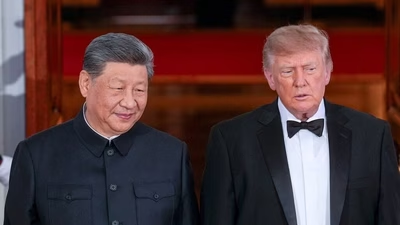
QUITE POSSIBLY both Donald Trump and Xi Jinping felt like winners at the end of their meeting in Washington. Each new display of pomp and pageantry —and there were many over the course of the three-day state visit—was crafted to flatter the dignity of the American and Chinese leaders. It was harder to detect substantive achievements from this parley between strongmen.
Instead, Mr Trump seemed bent on aping and outdoing China’s preferred version of a state visit. There were honour guards lining the red carpet as Mr Xi stepped off his plane, to be greeted by Mr Trump himself—a mark of esteem for a visiting head of state that has not been seen in decades, popes aside. The time for one-on-one talks was brief. Far from seeking a free-ranging press conference, Mr Trump staged tightly choreographed photo opportunities, and was overheard by photographers praising the friendliness and deference of Chinese journalists in Mr Xi’s entourage. American news organisations that had been banned from the White House for displeasing Mr Trump were suing the president even as the visit unfolded, as Mr Xi doubtless knew, though his poker face gave nothing away.
Mr Trump offered Mr Xi a brief glimpse of the White House ballroom that he is building, and that he has previously said was inspired by his admiration for the vast Great Hall of the People in Beijing.
That tangle of words actually describes a straightforward ambition. China hopes to construct a safe enclosure around the bilateral competition with America, made up of red lines that must not be crossed. The thickest and reddest of those lines concern Taiwan. China has been trying for some time to nudge Mr Trump to say that he opposes the island seeking formal independence. That would mark a change from America’s current stance, which is to say that it does not support Taiwanese independence. Though the distinction sounds arcane, such a statement from a president would induce alarm on the island, for it would seem to rule out American help in the event of a war triggered by a Taiwanese government that definitively rejected rule from Beijing. This Washington meeting saw China try again, with an official Chinese readout saying that opposition to an independent Taiwan is the foundation of stable relations. As Mr Xi took off, there was no evidence that Mr Trump had ceded ground on this point.
Because all possible doubters have been purged, it helps him to be seen ascending to a new level of global stature, though he hardly has to worry about anyone opposing this plan, in part. For Mr Xi, being treated as an equal by Mr Trump was an imperative, and not just for the sake of his pride. Mr Xi is expected to seek a fourth term as leader at a party congress next year.
On the Chinese side, Mr Xi’s aims were also more self-serving than his lofty rhetoric about peace and the “progress of humanity” might suggest. As for China’s national interest, Mr Xi’s stated aim was to bind Mr Trump and America to a form of peaceful co-existence that Chinese officials call “a constructive China-US relationship of strategic stability”.
