
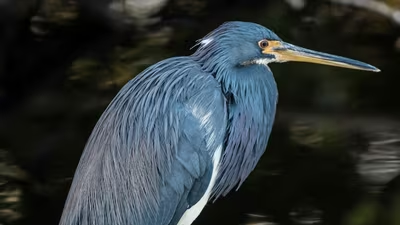
This question has been around for many years. It has been a mystery since scientists and bird enthusiasts first encountered the dark, shiny bird among the black rocks of the Galápagos Islands.
The Galápagos lava heron, considered by many researchers to be nothing more than a subspecies of the striated heron from South America, turns out to be its own distinct species after all, according to a study published in the journal Molecular Phylogenetics and Evolution.
San Francisco State University , which detailed the research behind the discovery, reported that the person who took on the puzzle was Ezra Mendales, a graduate student working on his master’s thesis. The team also examined specimens from the California Academy of Sciences, the American Museum of Natural History, and the Field Museum to study birds from different locations and capture the range of plumage variation. In 2022, Mendales, Jaime Chaves, and Jack Dumbacher traveled to the Galápagos to collect samples, with a Galápagos National Park ranger helping them catch herons so they could obtain blood samples for genetic analysis. Researchers then compared physical traits, including wing length, leg length, and bill size, across more than 300 preserved and live herons collected from five continents.
A distinct species with a surprising evolutionary history
The genetic analysis provided new clues about where the lava heron belongs on the avian tree of life. Using sequencing methods to examine thousands of highly conserved DNA regions, the scientists discovered that lava herons were not, in fact, closely related to the mainland South American striated heron, as had long been assumed. Their closest relatives turned out to be green herons from North and Central America. A distinctive feature of the lava heron is its longer, sturdier bill. Perhaps the most telling finding involved those lighter, striped individuals that had confused observers for generations. Genetic testing showed they were not mainland wanderers at all. They were lava herons through and through, simply carrying a different feather pattern within the same species. What had looked like two separate populations was actually normal variation within one Galápagos bird species. The finding is another piece in a growing puzzle concerning a number of other Galápagos birds, such as Darwin’s finches and the Galápagos mockingbird, which have relatives with evolutionary origins in North America as well as South America. These relationships offer further clues about how different bird lineages arrived on and colonized the distant volcanic islands. The lava heron’s recognition as a distinct species also shows how genetic analysis can reshape scientists’ understanding of animals that have been studied for generations. Even in a well-studied ecosystem such as the Galápagos, researchers can still uncover new details about the evolutionary history and diversity of its wildlife.
The lava heron and green heron belong to the same genus, Butorides, but their evolutionary lineages diverged around 1.3 million years ago, long before humans arrived in the islands. A 2009 study in Waterbirds found that the species has a more robust bill than South American striated herons, a difference the researchers linked to the importance of crabs in its diet.
