
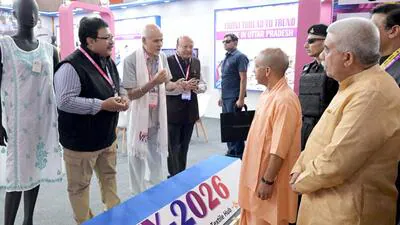
Chief minister Yogi Adityanath on Tuesday said UP stands for “unlimited potential”, and its rich heritage, young workforce, industrial base and vast market could help the state emerge as a global textile hub.
Addressing the inaugural session of the UP Textile Conclave-2026 here, Adityanath said the state had undergone a transformation since 2017 and was now home to the world’s youngest workforce.
During the event, the chief minister launched the ‘UP Tech Mitra’ portal and inaugurated the Handloom Weaver Prosperity Scheme (Hathkargha Bunkar Samriddhi Yojana). “This is a transformed UP. We now have the world’s youngest workforce. He cited Varanasi’s silk sarees, Bhadohi’s carpets, Lucknow’s chikankari, Bareilly’s zari work, Kanpur’s textile ecosystem and Meerut’s potential in technical textiles as examples of the state’s heritage and industrial strength.
MoUs worth ₹ 5,196 crore for fresh investments in the textile sector were signed, while Letters of Comfort worth ₹ 163 crore and subsidies amounting to ₹ 60 crore were distributed. The chief minister said 17 textile products from UP had received Geographical Indication (GI) tags, while lakhs of women were becoming self-reliant through self-help groups. He said handicraft exports stood at around ₹ 35,000 crore in 2025-26, while more than two lakh handloom weavers contributed to exports exceeding ₹ 110 crore.
Leveraging this strength, the aim is to transform Uttar Pradesh into a global textile hub,” he said, adding that the government wanted to develop the entire value chain within the state—from fibre to yarn, yarn to fabric, fabric to garment and garment to brand—before taking products to global markets. Adityanath said UP’s textile identity dated back thousands of years, with references to the silk fabrics of Kashi found in ancient texts, including Vedic literature, the Ramayana and the Mahabharata. He said the textile industry was the second-largest source of employment after agriculture. Textile industry minister Rakesh Sachan said investment-friendly policies had given fresh momentum to infrastructure and industry.
