
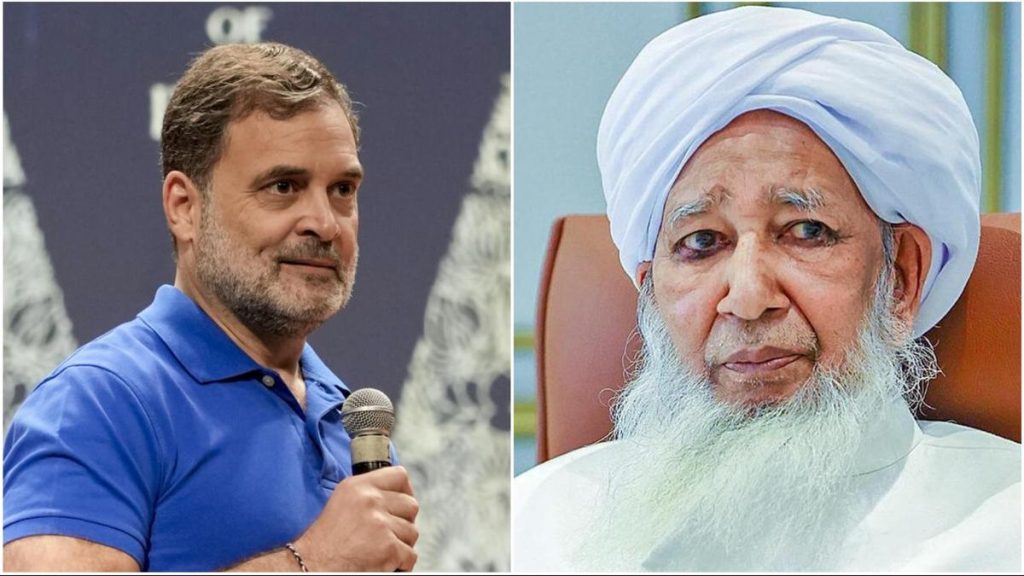
Two ongoing debates point to the double standards that Indian progressives confront. The central question relates to how an old text could be read and spoken about in the context of the present. Congress leader Rahul Gandhi has made the complete rejection of Manusmriti the defining agenda of his politics, and points out that it dictates inferior roles for women; in Keralam, Islamic scholar Kanthapuram A.P.
Aboobacker Musliyar has said the Quran dictates an inferior role for women in society, saying, “The Holy Quran states that women should live confined within their homes and must not make public appearances.”
Mr. Gandhi’s attribution to the Manusmriti, shared by many progressive people, is reprobatory; the second, to the Quran, is appreciatory from the vantage point of the cleric. What is the right thing to do? All liberal, progressive voices tend to think the role ascribed to women in the Manusmriti or Quran is unacceptable in a modern, secular constitutional republic. The foundational ethos of a democracy demands that every citizen, irrespective of gender, be guaranteed liberty, equality and dignity. One approach is to reject the entire text — which some critics of the Manusmriti and the Quran do. Critics and admirers of all old texts have originalists among them. The originalists and the literalists can uphold or reject the original, literal meaning of the Manusmriti or the Quran as the case may be. A second approach is to reinterpret the text and its context and argue that the verses in the Manusmriti and the Quran cannot be read in isolation, and that there are instances of women playing leadership roles in early Islamic societies and ancient Indian traditions and texts. They suggest that the core philosophies underlying these verses can be repurposed for the modern era. Now, let’s turn to who is in which camp. The camp that can be broadly termed Indian cultural nationalists thinks that, for the Quran, the text itself is the problem and there is little that innovative interpretation can do to redeem it. Yet, this same faction becomes fiercely defensive of texts that are part of their own traditions. They are out to liberate Muslim women, but see no correlation between the status of Hindu women and their religious practices. Orthodoxy redux: Editorial on Keralam, religion and Muslim women’s rights A mirror image of the same is enacted by a predominant section of the secular progressive segment, which is effortless in its complete condemnation of the Manusmriti, but when it comes to the Quran, it seeks to offer explanations and interpretations in order to pointedly avoid the complete rejection of the text. They somehow think that admitting to the problematic aspects of minority traditions can help majoritarianism, and often twist themselves in knots. Of course, there is a strand of secular rationalists that treats all religious texts with equal contempt. There is a long tradition of Quran followers who reject any local accretion or interpretation of its tenets and practices. There are also Muslims who reject the claims of people such as the cleric cited above. Selective reinterpretation and condemnation of texts are guided by both political calculation and theological fealty. Moreover, the boundaries between state law and religious tradition are porous, constantly bleeding into one another. So, progressive thinking could take three paths: to reject all texts in their entirety, to repurpose them in progressive terms or to be agnostic about them. All paths have pros and cons, and there is no easy answer. M.K. Gandhi, an astute nation-builder, took the second path of reinterpreting the traditions for the modern world.
Both interpretations share the commonality that they attribute a certain meaning to two ancient texts — Manusmriti, said to have been written between the 2nd century BCE and the 3rd century CE; and the Quran, believed to be written between 610 CE and 632 CE. Because there are two ways to treat the texts in these cases, but beyond that point, the contradictions begin,. Because modern law also protects religious faiths, but that is easier said than done,.
There can also be a third way — it does not matter what either the Manusmriti or the Quran says about anything in public life. One can take the view that life today is governed by the Constitution and the rule of law, and not by any ancient text.
