
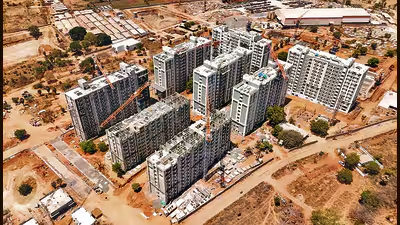
To accommodate the large number of migrant workers arriving in the city, the newly notified Master Plan for Delhi 2047 has incorporated rental housing into the city’s statutory planning framework for the first time.
The success of the southern state lies in its approach that treats rental housing as industrial infrastructure rather than a standalone real-estate product. It also renewed optimism for the Centre’s six-year-old initiative to develop formal rental housing under the flagship Pradhan Mantri Awas Yojana-Urban (PMAY-U), which has resulted in fewer than 47,000 occupied units nationwide, with as many as 40,630 in just one state—Tamil Nadu.
A separate industrial housing scheme meant to complement ARHC is similarly stalled. Notified last week, Affordable Rental Housing Complexes (ARHC) will come as single-bedroom and double-bedroom units, with carpet areas of up to 30 sqm and 60 sqm respectively, as well as dormitories and basic common facilities, according to Delhi MP 2047. Dedicated ARHC premises will be allowed a maximum floor area ratio (FAR) of 300, subject to a minimum plot size of 2,000 sqm and a 12-metre abutting road. Urban homelessness in India stands at 13 per 10,000 people, while the share of affordable housing in new supply in the country’s eight largest cities declined from 52% in 2018 to 17% in 2025, according to the UN-Habitat World Cities Report 2026. But under ARHC, among the 83,534 vacant government houses identified nationally for conversion under Model-1, only 5,783, about 7%, have become rental housing, with just 80% of those occupied. It received its first dedicated budget allocation of ₹ 2,500 crore in 2025-26, but this was cut to zero at the revised estimate stage. Its 2026-27 budget estimate has fallen to ₹ 400 crore. Under Model-2 (new construction), 83,298 units have been approved across India so far, of which 40,630 are complete, according to a reply in Parliament on August 10, and all of them are in Tamil Nadu. The other six states with approved projects—Chhattisgarh, Assam, Uttar Pradesh, Gujarat, Telangana and Andhra Pradesh—account for 21,887 units sanctioned for entities, including Indian Oil Corporation and Sivani Infra, none of which have been completed.
Another 7,413 units are “under process” across Gujarat, Himachal Pradesh, Haryana, Madhya Pradesh and Rajasthan. The union housing and urban affairs ministry told the parliamentary panel in a parliamentary standing committee report tabled on August 11 that the scheme remains “under conceptualisation”, with stakeholder consultations continuing before it can go to the cabinet for approval. A senior official at the state-owned Tamil Nadu Infrastructure Fund Management Corporation, which funds several of the state’s affordable-housing projects, said the model is designed around demand: “Rental housing in the state is positioned as part of industrial infrastructure, ensuring a steady pipeline of occupants. The official, speaking anonymously and citing the budget session in the state assembly, said the programme will continue under the new state government, as affordable housing has received an increased allocation in the budget estimates. Debarpita Roy, lead research centre for public policy on housing and habitat at NIUA, said scaling affordable rental housing will require stronger state-private sector engagement. “The ARHC sub-scheme is a good setup, states now need to work with the private sector and vice-versa to make rental housing work,” she said.
