
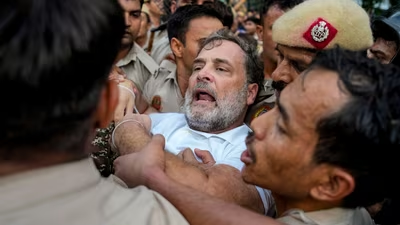
Opposition politics took centre stage in the Capital on Tuesday as Congress leader Rahul Gandhi led an unprecedented protest outside the Prime Minister’s residence and a string of leaders visited Jantar Mantar to back agitating students, ratcheting up the political temperature a day after massive street protests over exam paper leaks rocked Delhi.
Event Context
For about three-and-a-half hours, Gandhi, Congress chief Mallikarjun Kharge, senior leader Priyanka Gandhi Vadra, and a 200-strong crowd sat in solidarity with protesting students at the Lok Kalyan Marg and Akbar Road crossing, before being forcibly dragged away by Delhi Police and bundled in buses.
ALSO READ | ‘Modi allowed it to weaken CJP’: AAP sees ‘jugalbandi’ in Rahul’s protest near PM house, Cong and BJP react
Gandhi was taken to Chattrasal Stadium in north Delhi and released at around 10pm. Priyanka Gandhi was taken to Mandir Marg police station in central Delhi, where former Congress chief Sonia Gandhi reached late in the evening. She was released at 9.45pm.
The government sent Union minister Jitendra Singh and Union home secretary Govind Mohan to negotiate with Gandhi but was unsuccessful. Singh later alleged the Centre accepted Gandhi’s first demand for a parliamentary discussion on NEET but the leader of the Opposition in the Lok Sabha went back on his word, and refused to vacate the high-security zone.
Roughly 6km away, the Cockroach Janata Party (CJP) and student protesters recouped and rebuilt their stir demanding Union education minister Dharmendra Pradhan’s resignation as hundreds of people poured into the site. On Monday, the 23-day-old sit-in hunger strike at Jantar Mantar snowballed into the largest public protest in Modi’s third term, as tens of thousands of people marched to Parliament, braving police batons, tear gas and scores of barricades.
NCP (SP) leader Sharad Pawar, Aam Aadmi Party chief Arvind Kejriwal and Shiv Sena (UBT) chief Uddhav Thackeray met the students in Jantar Mantar.
Earlier in the day, Union health minister JP Nadda and Gandhi both visited the hospital to meet injured students.
ALSO READ | Dharmendra Pradhan’s first reaction to CJP protest: ‘Rahul Gandhi using students as political tools’
As police swooped down on the site at around 4.30pm, Gandhi was seen on the ground and resisting as personnel tried to pick him up. “Leader of the Opposition Shri Rahul Gandhi has been forcibly removed. What kind of democracy is this?” Kharge said on X.
This is the first time a leader of the Opposition, who enjoys the rank of a cabinet minister, sat on a stir near the PM’s house.
People aware of the details said the government was open to talks with the students and CJP representatives but refused to give an assurance to meet their demands nor a time frame for the next rounds of meetings.
Singh and Pradhan condemned Gandhi’s stir.
He said Gandhi asked the NEET issues and student movement to be discussed in Parliament before ending his sit-in. “Within a few moments, after taking permission from the government’s top leadership, Rahul Gandhi was assured that his demand had been accepted…When this information was conveyed to Rahul Gandhi, he said that he would not agree to this alone but also sought assurance for the resignation of the Union education minister,” Singh added.
The minister said when Gandhi was reminded that earlier he had only demanded discussion, he said his demands had changed. “When an attempt was made to humbly explain to him that for a senior leader like him to backtrack from his word so quickly does not befit him, he said that it is his prerogative. When the home secretary tried to explain that this site is not suitable for a sit-in, his response was that it is also his prerogative to sit wherever he wants…For a senior leader like Rahul Gandhi and the Leader of the Opposition to go back on his word is unfortunate and contrary to every norm of democracy. The government is ready to discuss in Parliament all issues related to NEET and the associated movement,” Singh said.
Pradhan accused Gandhi of using students as a political tool to disrupt the monsoon session. “For Rahul Gandhi, this is not about students. This is about manufacturing confrontation after every genuine avenue for discussion has been opened. Our Government remains 100% committed to discussing NEET and addressing every genuine concern of our youth on the floor of the House. The students of India deserve far better than being treated as props in a political campaign,” he posted on X.
Born out of a controversial remark by Chief Justice of India Surya Kant earlier this year, the CJP first garnered millions of followers on social media before launching a sit-in protest on June 6 demanding the resignation of Pradhan over repeated question paper leaks. After days of tepid crowds, the movement was galvanised by the hunger strike and forcible removal of activist Sonam Wangchuk last week.
Crowds swelled through the weekend and by Monday morning, columns of people – many of them students, first-time agitators and young professionals – had defied a steady monsoon drizzle and heavy police barricading to join what became the largest street protests in the Capital in years.
Protest outside PM’s residence
Gandhi rallied party MPs, two chief ministers and allies, including Samajwadi Party chief Akhilesh Yadav and Nationalist Congress Party (Sharadchandra Pawar) leader Supriya Sule, for an impromptu protest outside Prime Minister Narendra Modi’s residence at 7, Lok Kalyan Marg.
The dramatic protests outside the PM’s residence began shortly after 3pm.
“An attack on students is an attack on every Indian family. Prime Minister Modi thinks he can escape without giving answers, without facing any consequences – he won’t be able to, not at all this time…I ask every patriotic Indian who believes our students deserve justice — join us in dharna in front of the Prime Minister’s residence. The voice of India’s students will not be ignored,” Gandhi said.
“Some time ago, it came to light that the Congress party’s national president, Mallikarjun Kharge, and other senior leaders with him, such as Rahul Gandhi, Priyanka Gandhi, and others, suddenly sat down for a sit-in protest near Akbar Road at a location with their supporters. In view of the dignity of this senior delegation, the government sent me personally, along with the Union home secretary, Govind Mohan, to the spot to hold talks with these senior leaders. A request was made to Rahul Gandhi to end his sit-in, as this site is not meant for protests, and holding a sit-in here is causing considerable inconvenience to the general public,” Singh wrote on X.
His party colleagues attacked Gandhi. “To weaken the CJP’s dharna, Modi ji has seated Rahul Gandhi on a dharna at his residence,” party MP Sanjay Singh posted on X.
The government criticised the Congress for protesting outside the PM’s residence, claiming it was a breach of security. “The conduct displayed today by LoP Rahul Gandhi is entirely unbecoming and condemnable,” BJP president Nitin Nabin said. But opposition leaders pointed out that such sit-ins were common.
In 2011, supporters of the anti-corruption crusade led by Anna Hazare held a peaceful demonstration outside the residence of then PM Manmohan Singh. Over 400 protesters were detained and later released.
In 2013, about 200 BJP’s youth wing members were detained outside PM Singh’s residence while they demanded his resignation after two Union ministers quit over charges of impropriety. The activists of the Bharatiya Janata Yuva Morcha (BJYM) were led by then BJYM chief Anurag Thakur and BJP’s then Delhi unit chief, Vijay Goel.
Congress general secretary KC Venugopal also attacked the government. “The government showed their brutality yesterday. Today, they have repeated this brutality..they are completely non-democratic.”
How the movement gathered momentum
During the police crackdown that followed, Gandhi could be seen lying down on the road, refusing to move. Rajya Sabha MP Renuka Chowdhury sat on the bus stairs, blocking the police. Kerala chief minister VD Satheesan and Karnataka CM DK Shivakumar also joined the protests.
Earlier in the day, Kharge told HT that, “The Opposition had proposed to both Lok Sabha Speaker Om Birla and Rajya Sabha chairman CP Radhakrishnan to hold a debate on the NEET and other exam paper leaks and the brutal crackdown on the students in Delhi on Monday. The government has not agreed to us. We will continue the protests.” Kharge also met Yadav. The latter favoured protests.
Parliament continued to be disrupted for the second consecutive day, as opposition leaders sought to raise the issue of paper leaks and other irregularities. The students, who are continuing to sit in at Jantar Mantar, got support from various opposition parties. “The treatment meted out to the students who were fighting for their just demands yesterday is unworthy of democratic values,” Pawar said.
Also at Jantar Mantar were Shiv Sena (UBT) MPs Sanjay Raut and Arvind Sawant, Rajya Sabha MP Mahua Majhi, AAP leader Gopal Rai, Kerala Congress (M) leader Jose K Mani, and a delegation from Left parties.
“The Modi government attacked these children with extreme brutality. These children were unarmed; they had no weapons, no sticks, no batons–nothing at all…Modi Ji has attacked these children with immense cruelty,” Kejriwal said.
